
Capt William Pettit: A 1690s Carolina Mariner and His Ties to Infamous Pirates Part 2
Part II: Detailed information on Captain William Pettit in chronological format.
Pettit Family Genealogy and History
Pettit Family History, Genealogy, Message Board, Research Papers and Blog
Part II: Detailed information on Captain William Pettit in chronological format.
Part I: Pettit lived during the golden age of piracy in a place that was unofficially welcoming of pirates and their golden bribes. In life, William Pettit lived near and did business with some of the most successful buccaneers that ever lived. Records indicate he held close ties to a maritime syndicate of reformed pirates who had used their fortune to buy a place for themselves in high society. He managed to quickly recover from a ruinous disaster by seizing a rare opportunity to help the powers of the colony flip a ghost pirate ship.
An entire branch of Spartanburg Pettits was missing. Below is the brief story of how they were recently discovered. If you are from this Austin Pettit line, this is the story of how your ancestor was rediscovered. After reading, please please contact The Pettit Research Project here! You have cousins who have been looking for you.

Download the complete book for free from The Pettit Research Project: Nathan Pettit 1775-1855 of Spartanburg SC and Hancock, IL, Book.PDF Currently Reading Part III Read Part I Here Read Part II Here FAMILY…
From his front porch, Nathan could survey his 80-acre spread and plan all the work that needed to be done tomorrow. Perhaps in these quiet moments his mind would take him back to his early years in the back country of South Carolina. His boyhood home was hundreds of miles away; over the rugged mountains he had once led his family through.
Nathan grew up in back country South Carolina during its most savagely violent period. His older brother Henry Pettit, Sr., and father Joshua defended their homeland while in the Spartan Regiment under Colonel Benjamin Roebuck. Nathan would have been about five years old when the patriot troops under Brigadier General Thomas Sumter stopped by the Pettit farm for provisions. The Pettit family supplied them with beef from their herd.

Our plan was to navigate down the Pacolet River and camp under the stars on the land that once belonged to Henry Pettit and William Poole. We set out to explore the old Poole Springs (Healing Springs), Pettit Mill Branch, Tumbling Shoals, Lawsons Fork, and various other sites. We planned to exit the river the next evening at Pacolet Mills.

A family record written by Joshua Pettit of Spartanburg Co., SC notes that he was married to a woman named Rachel who was the mother of several children. A family Bible record written by his son Henry Pettit Sr notes basically the same information.
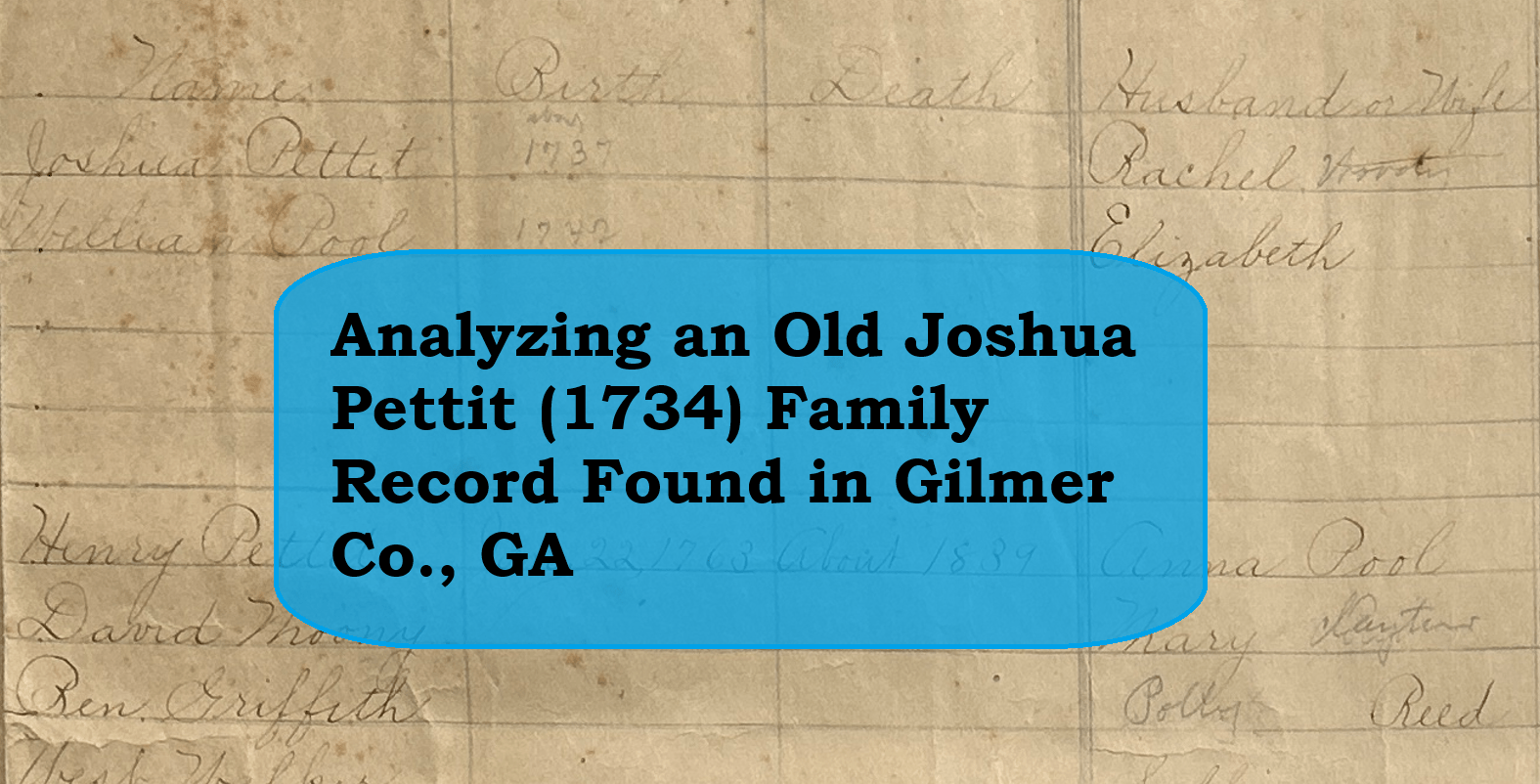
This old Pettit family record from Gilmer County, GA begins with the families of Joshua and Rachel Pettit and William and Elizabeth Poole of Spartanburg County, SC. Though we do not know for certain, the evidence suggests this record was written down by someone in the family of Rev. John Fulton Pettit sometime shortly after May 21, 1898.
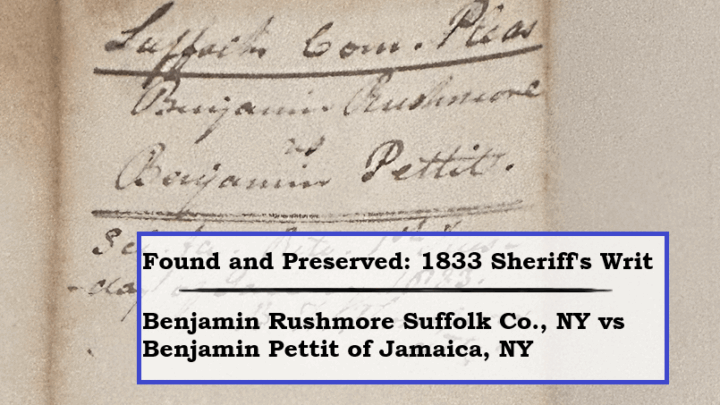
In June of 2025 The Pettit Research Project acquired this 1833 Sheriff’s writ from an antique document dealer in New York. The dealer was unsure of the paper’s origins but believed she had purchased it about 25 years ago from the estate of Tim Green who was a lawyer in Southhold, NY. The document is a legal writ from the Court of Common Pleas in Suffolk County, NY on behalf of Benjamin Rushmore of Riverhead. Rushmore sued Benjamin Pettit of Jamaica, NY for $206.26 1/2.
In 1795 a survey was conducted for William Poole in Spartanburg County, 96 District, South Carolina. This plat was for 23 acres of land which included the “Healing Springs”. It was situated on the south side of the Pacolet River near Lawson’s Fork. Neighbors included Henry Pettit Sr, as well as Rutledge and Henderson.
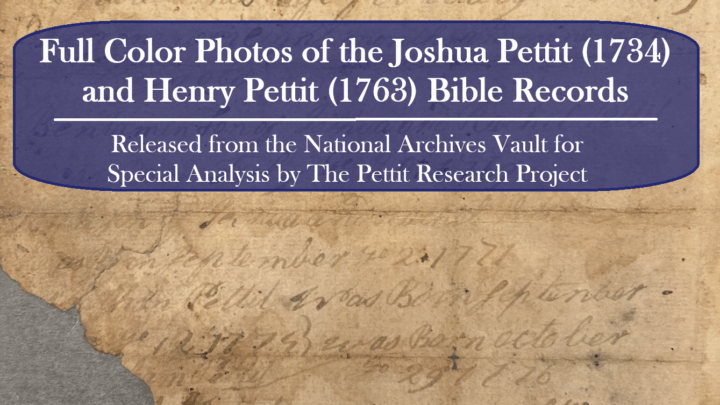
Fortunately, in May of 2025, The Pettit Research Project was granted special access to the the Henry Pettit Sr. Revolutionary War Pension file at the National Archives in Washington, DC. The folder containing his records was removed from the vault and given to this researcher by the lead archivist. Examination of the contents was permitted under his supervision for safe handling and security reasons.
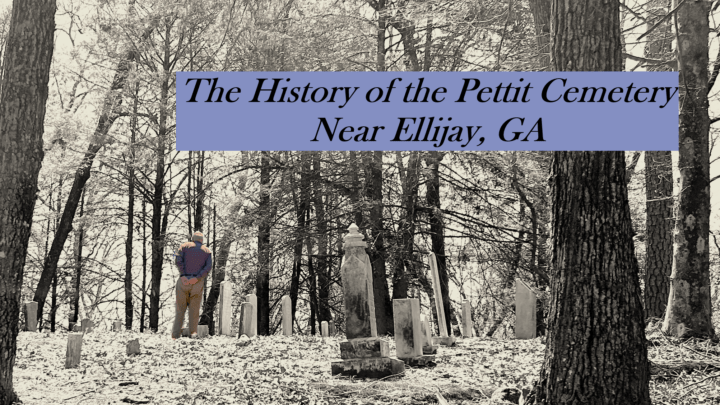
Pettit Cemetery Origins Three weeks before his 21st birthday William Decatur Pettit should have been a young man in his prime. Instead, he lay sick in bed. At his home on the Pettit farm near…

The date it was written is not given though it would have certainly been within the author’s lifetime of 1870-1940. The story opens with an account of the movement from North Carolina to Gilmer County, GA of Henry Pettit Jr (b.1790), his brother John Pettit, and son Elijah Pool Pettit and their families. The story covers several allied families as well, most notably the Griffiths, Ellingtons, and Kings.
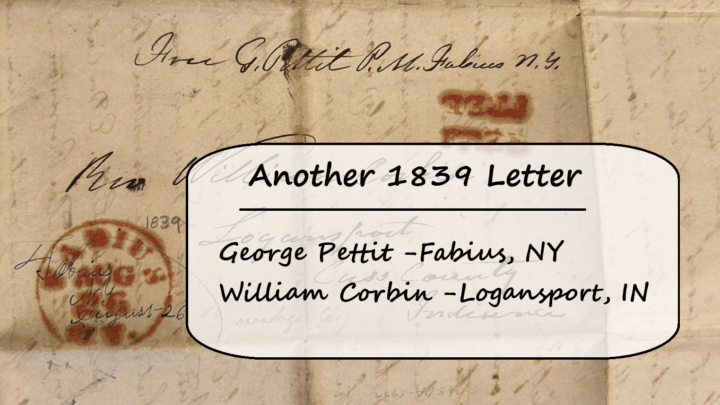
1839 Letter from George Pettit in Fabius, NY to William Corbin Logansport, IN As mentioned in another article, in January of 2025, The Pettit Research Project acquired a letter written on April 5, 1839, by…
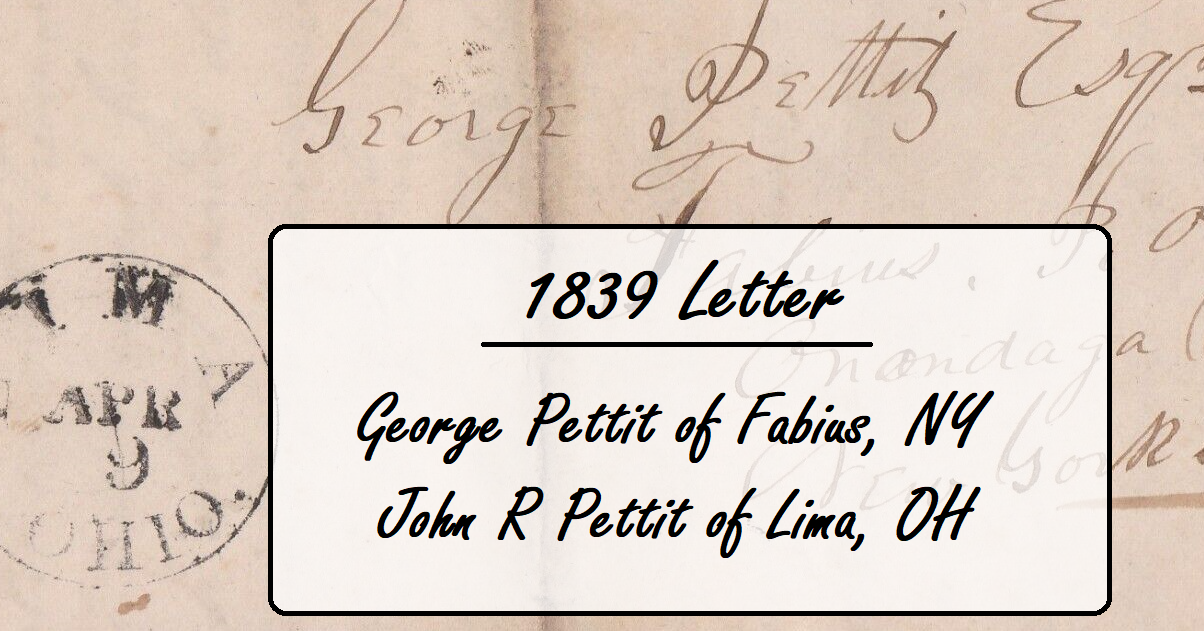
On April 5, 1839, George Pettit (1780-1866) of Fabius, NY wrote this letter to his brother John Riddell Pettit (1793-1855) in Lima, OH. In it George discusses his fluctuating health and his plans to sell the farm and move to the northwest. He mentions their brother David Pettit and David’s son Jonathan Pettit.
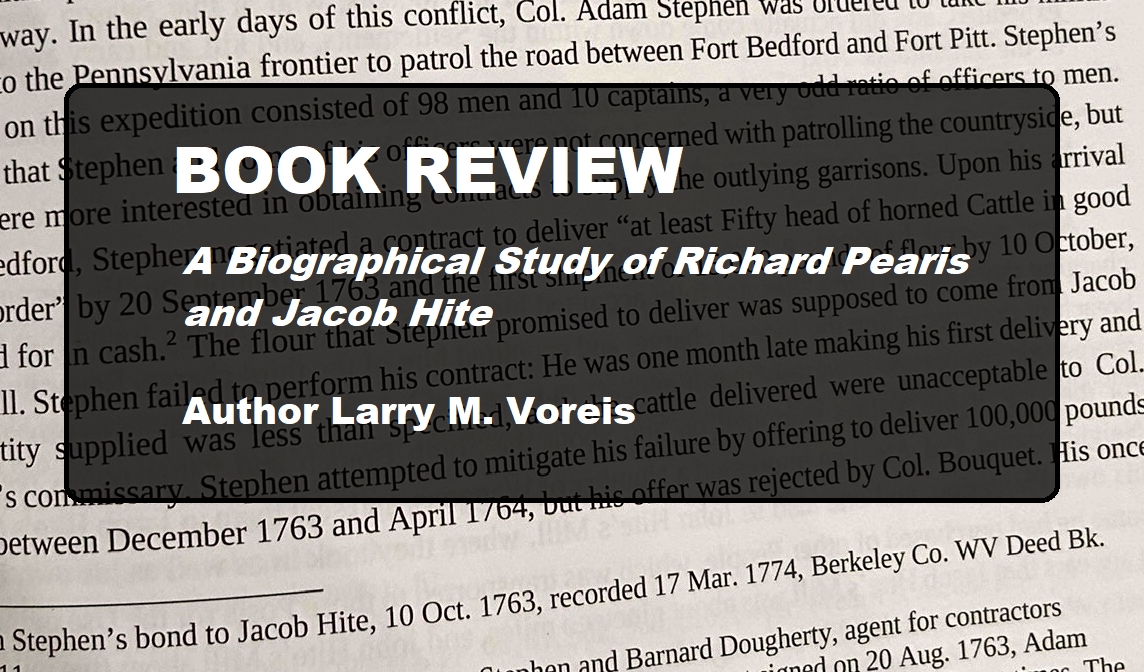
Expect to walk away from this read with a deeper understanding of not only Richard Pearis and Jacob Hite, but also the entire misunderstood and oft forgotten world in which they lived. If you are interested in Virginia or South Carolina colonial or Revolutionary period history, the fine details of Indian trade and traders, the dark and dirty deeds of Loyalists and Patriots in the struggle for independence, and the ultimate fate of those who were exiled from the United States, I strongly recommend these books.

Did Joshua Pettit (b1734) of Spartanburg County, SC speculate land in Effingham County, GA in the year 1784?

At least 6 Pettit Immigrants came to Virginia and Maryland in the early to mid 1600s.
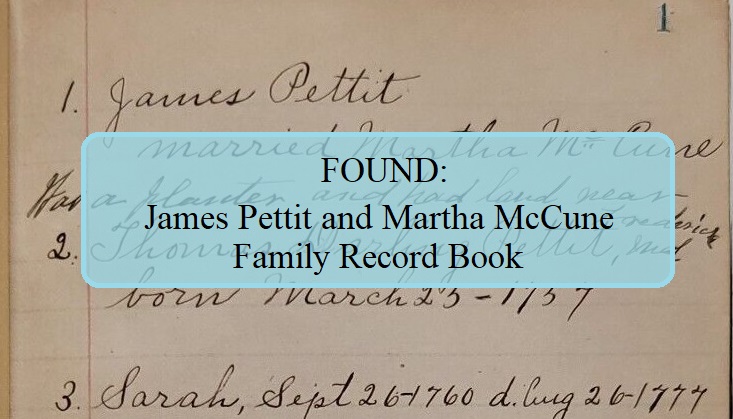
A James Pettit and Martha McCune Family Record Book was recently discovered which gives the names and birth dates of their children.
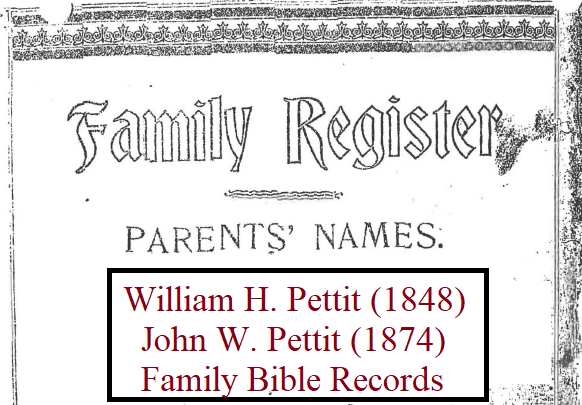
This Bible record appears to have been the work of multiple generations of Gilmer County, GA Pettits. The handwriting of three different people can be easily distinguished. The note that accompanied these pages said that it was the record of William Henry Pettit and “John Waitsel Pettit, father of Morris Pettit”. It is possible the information was taken down by William Henry Pettit, John Waitsel Pettit and Morris Pettit.
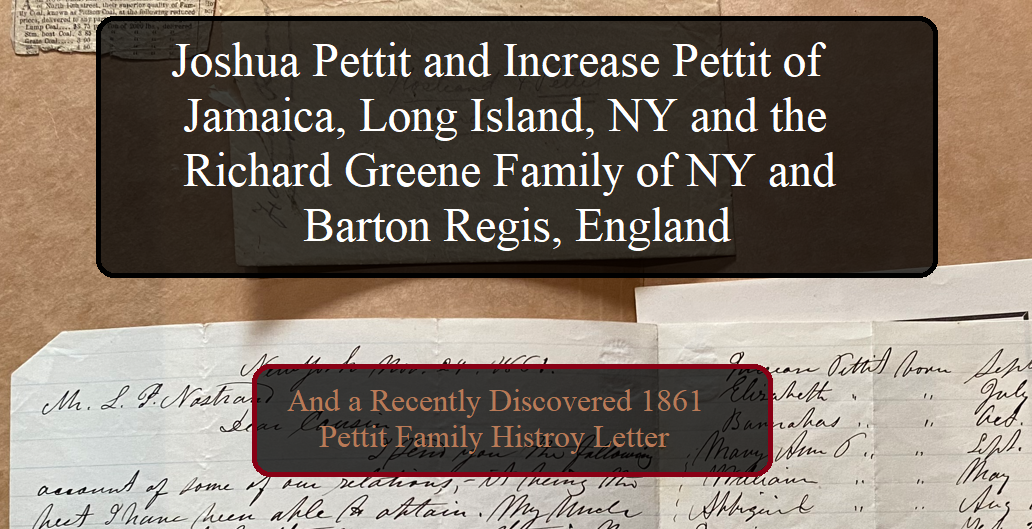
This folder contained a well preserved letter dated November 29, 1861, addressed to Mr. L. P. Nostrand in New York from a G. W. Pettit. It begins with a man named Joshua Pettit who was from Springfield, Long Island, NY. According to the letter, Joshua Pettit married a “rich English lady” and was the father of an Increase Pettit. In this paper we will compare this newly discovered letter to a deed found in Bristol England from the Ashton Court estate which may explain the source of some of these forgotten legends.
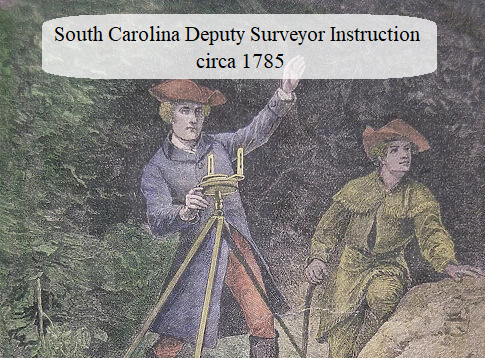
At the end of this document you will find the full text of the South Carolina General Assembly’s official instructions for the State’s Deputy Surveyors in place by 1785. Studying these brief instructions will help researchers properly interpret and understand the land warrant and survey process in South Carolina and contextualize early grants of vacant land.
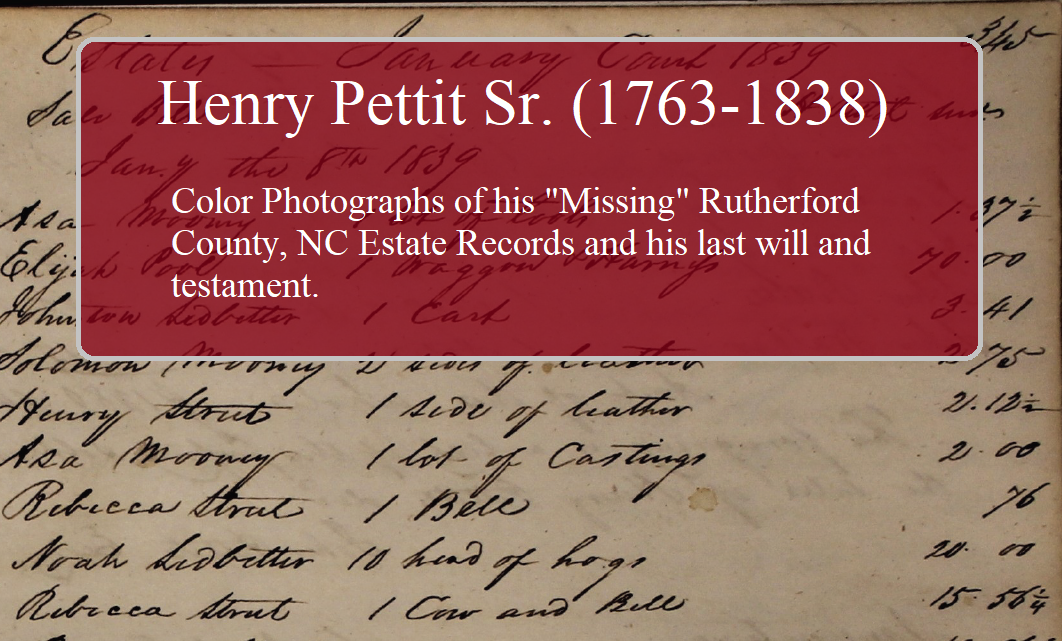
Though the will had been discovered many years ago, the estate papers of Henry Pettit Sr. (1763-1838) seemed to be missing. The record book, which was presumed to be lost, has been found in the state archives. It had somehow missed being microfilmed. The full estate papers of Henry Pettit Sr of Rutherford Co., NC are now available.
“John But Not Forgotten” John Pettit Born 1771, Son of Joshua and Rachel Pettit of Spartanburg Co, SC This article will broadly cover the life of John Pettit the son of Joshua and Rachel Pettit…
John Pettit, grandson of Joshua and Judith Poole Pettit was born in 1820 in Spartanburg Co., SC. He married three times and had 20 children. His descendants are numerous and spread out to AL, MS and beyond. Some of them still own portions of the land that once belonged to his grandparents in SC. John is buried in the Thompson Chapel cemetery not far from the old Pettit land and near the Pettit family cemetery in SC.

James Pettet was born in the town of Westfield County of Saraotga Washington N.Y. on the 20th day of April AD 1798. Eleanor Bennett was born in the town of Halfmoon on the 17th day of April AD 1803.
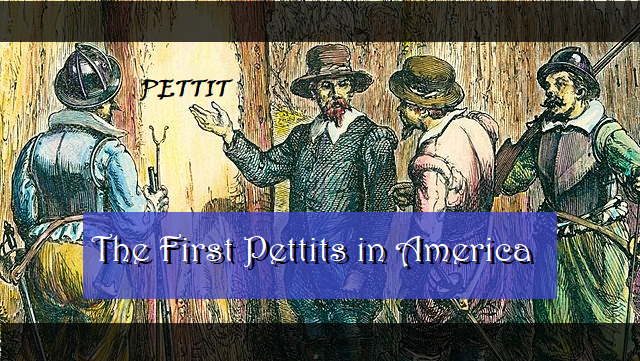
Thomas Petite and his wife came to the Province of Maryland in the year 1639. In 1645 Thomas imported a child named Catherine Petite who is presumed to be his daughter though the record never explicitly declares this. By 1649 he had acquired the right and title to 450 acres of land near the lower Cedar Point on the north side of the Potomac River in western St. Mary County. His plantation was near what was once called Petite’s Creek.

“Unbuckle your gun belt carefully and drop your gun,” Pettit told him. Lewis unbuckled his gun and handed the whole outfit to me. Pettit reached for this handcuffs and just then the whole window burst out on him with shotgun shells. I covered Lewis and started for the door and at the same time Pettit went in through the window.
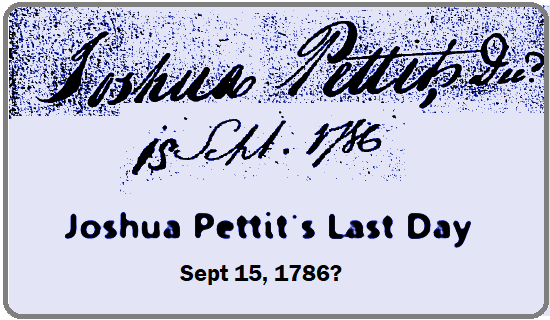
Many people believe Joshua Pettit of Spartanburg Co died on September 15, 1786. In this paper we will look at where this date originated and why it is not likely the day he died. We will examine the documents that surround the final years of old Joshua Pettit.
A Francis Pettit was born around 1612 and was living in Northampton County, VA as early as 1636. He owned a plantation near Cherrystone Creek on the Eastern Shore. He was married to a woman named Ann and had at least one son named Francis. He was also related in some manner to Obedience Robins.
It is said that a William Pettit (born around 1697) migrated to Louisa Co., VA around 1720. Some researchers claim William Pettit’s land of nativity was Ireland while others state that he came from France. Though vastly different countries, these two origins need not be mutually exclusive. It is very possible he (or his parents) came to Ireland after leaving France in the protestant migration.
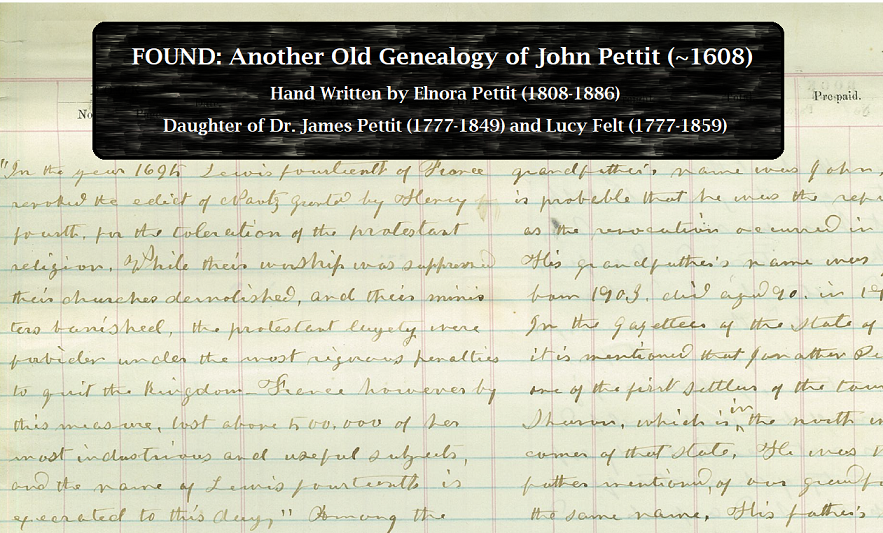
“In my possession is a record given by my grandfather Johnathan Pettit, taken from his lips by my brother William, about the year 1825, of which the above is a copy also that his ancestry were farmers, persons of information, and respectability…”
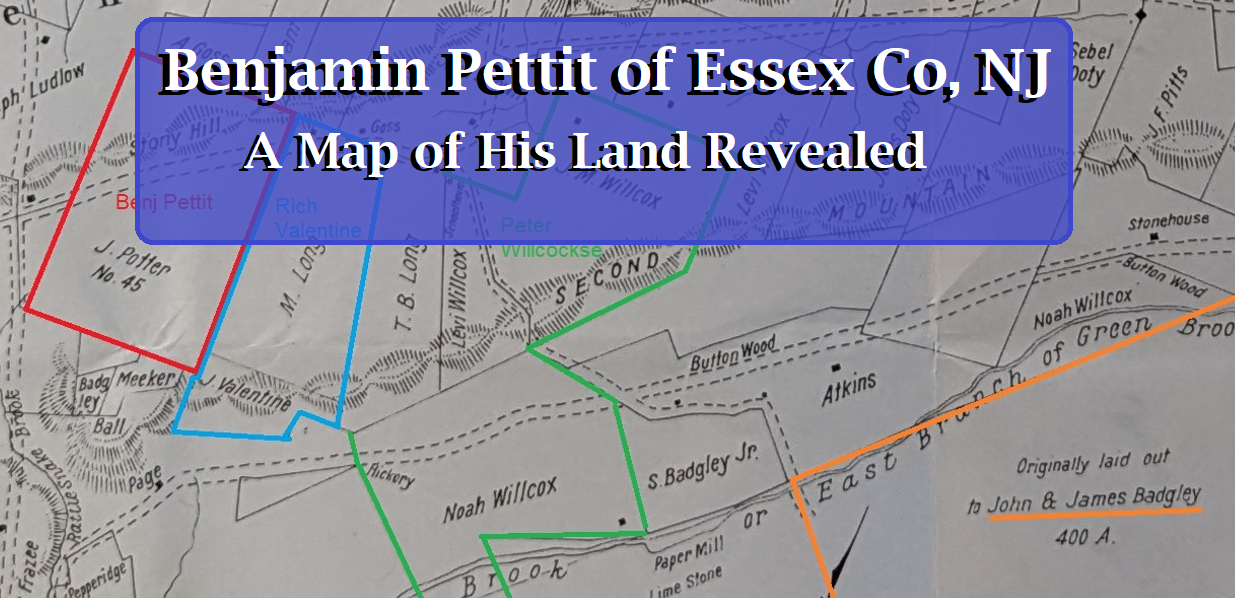
Benjamin Pettit of Essex Co., NJ owned lot #45 on Stony Hill. This land is shown on an 1845 map produced by historian John Littell. Neighbors that can be identified on this map include the Badgley, Frazee, Valentine, and Willcox families.

This pages provides a link to name indexes for the Pettit family tree so our cousins can easily find which Pettit clan they belong to.
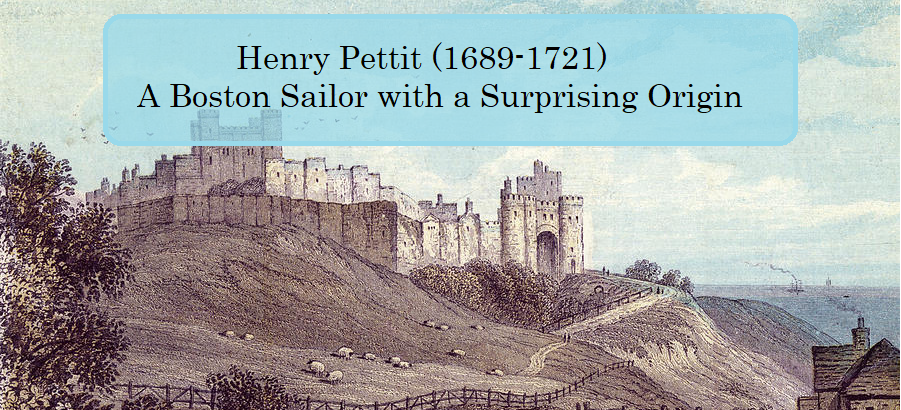
Wedding bells rang out on December 28, 1718, as Henry Pettit and Sarah Gibbs were married before the Reverend Sam Miles in Boston, MA. The Presbyterian marriage was just 3 days after Christmas Sunday. Sarah Gibbs was the daughter of John and Mary Gibbs of Boston. John Gibbs was a painter by trade, specializing in decorative staining and funeral escutcheons.
The origin of the Pettit family name. Who were the first Pettits and where did they come from?
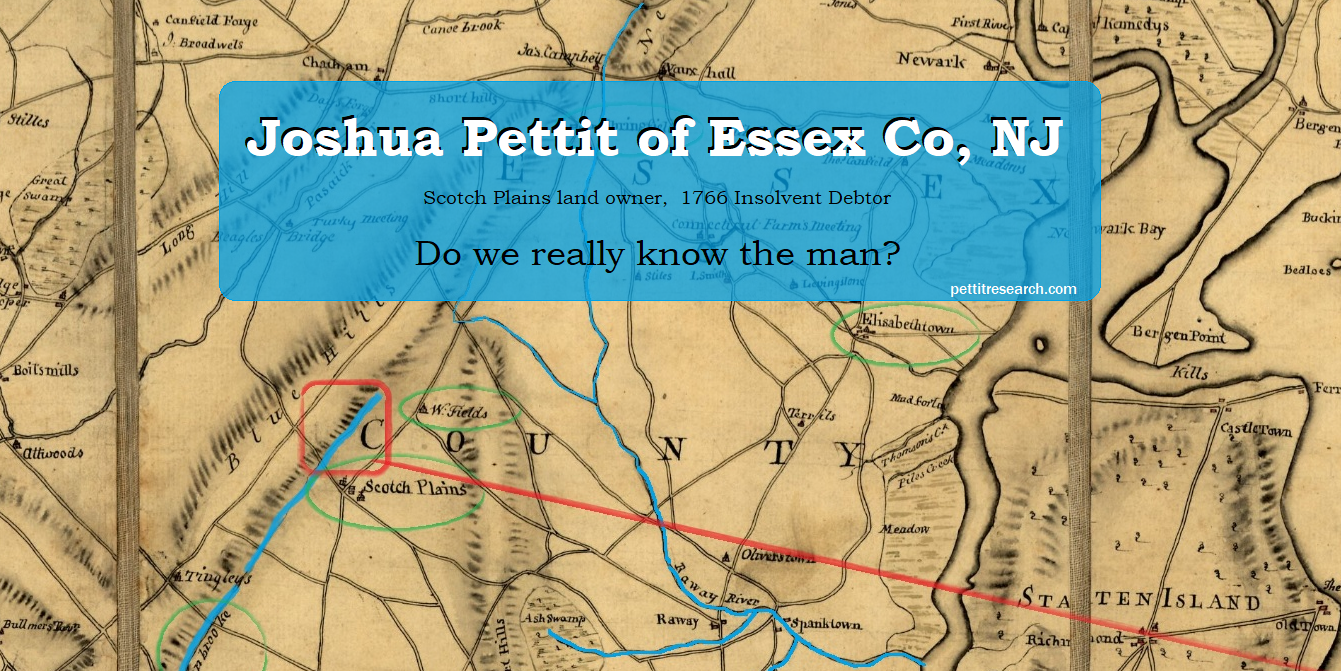
Now it is time to take this data and plot it out on a map. In doing so we will identify the most likely location of Joshua Pettit’s land in Scotch Plains, NJ and see where it would be located today.
The Valentine family was decimated by smallpox in the late winter of 1766. Two minor Pettit grandchildren were named as heirs. The Valentine, Baker, Osborn and Pettit families lived very near each other in the Stony Hill and Scotch Plains area near the Green Brook.
The reason Joshua Pettit’s petition cannot be found in the record books of the Court of Common Pleas is because he was not a free man. He was in one of the jails in Essex County for the “crime” of being an insolvent debtor.
The precise location of Joshua Pettit’s land in Essex County, New Jersey has long been a mystery. In this article we will attempt to determine where his land was relative to the geography of the 1700’s and where it can be found today.
Joshua Pettit (Josue Petit) a French Waldensian or Huguenot, arrived in Virginia in September of 1700 as a colonist bound for Manakintown.
John Pettit/Petit came to Virginia from France as early as 1638. He settled in the Charles River County area which would become York County. He was a surgeon. He petitioned the House of Burgese to become a ditizen in 1666. His will was written in 1669 and it revealed John Petit married a woman named Rebecca and had two daughters, Elizabeth and Margaret.
NOTE: There is every reason to believe this man’s name was Pettus and not Pettit. Unfortunately there are a number of genealogists who erroneously mix Thomas Pettus with Thomas Pettit and his wife Katherine who lived in a different area of Virginia. The information in this article is provided in order to help researchers keep the two men and their lives separated.
Thomas Pettit and Katherine his wife were in the Rappahannock River settlement in Virginia as early as 1656. They had one son, Thomas Pettit Jr and one daughter, Dorothy. It is likely that this Thomas is the ancestor of many of the Pettits in America today including those who trace their line back to Surry Co., NC.
The First Pettits in America Series. In this installment we look at the documents surrounding the immigration of Richard Pettit to Virginia in 1636 by Alexander Stomer.
Tracing the Rachel Monroe/Pettit legend down through the years and finding it’s surprising origin. What did the earliest Pettit genealogists think of this and why does it matter?
We will attempt to list all the known children of Joshua and Rachel Pettit and their birth date and birth place.
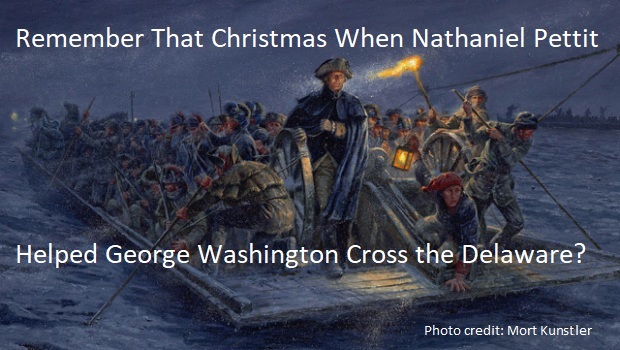
It was Christmas, 1776. Evening had just swept in. General George Washington looked out over the Delaware River as the first snowflakes began their gentle but ominous swirling descent into the darkening water below. He, like so many of the men under his command, had given up the warmth and comfort of his home to fight for a cause that now seemed desperately out of reach.

The story of how copies of the Benjamin Pettit (1769) family bible records have come down to us through the ages is one of intrigue. There are actually two distinct bible records in circulation among researchers which contain similar lists of the births of Benjamin and Elizabeth Pettit’s children.