Capt William Pettit: A 1690s Carolina Mariner and His Ties to Infamous Pirates Part 1
William Pettit was a ship captain who resided in early Charleston, South Carolina in the late 1600s during the golden age of piracy. The story of his life and his sorted dealings with several infamous pirates is one that simply must be told.
Mystery Ship
In 1692 Charles Towne was a young port city alone on the South Carolina coast. Though it was quickly becoming a major maritime trade hub, wharves where ships could easily dock had yet to be built. Merchant vessels anchored in the waters of the Cooper River, just off East Bay Street. There, smaller boats called lighters were used to load and unload them. English law that governed the town at the time forbade non-English vessels from engaging in commercial trade at English ports. French ships were dangerous enemies and would be driven off with cannon fire from the defensive batteries on the town’s shore. English privateer vessels (pirates who had commission from the English) were legally allowed. Pirates (those who plundered indiscriminately and swore allegiance to no country) were not. Ships entering port were required to display their national flag, known as an ensign, so that they could be easily identified as friend or foe.
In April 1692, the people of Charles Towne spotted a mysterious ship in the distance. It approached with a bare mast, giving no sign of its origin or intentions. This put the townsfolk on edge.
Across the ocean, England and France were in the midst of The Nine Years War. Though a distant conflict, this had major implications for the isolated colonists. French privateers, known as corsairs, frequently attacked coastal settlements. There would have been concern that this unrecognized ship might be the first of a French fleet, there to pillage the city.
As the wind filled its sails, the unidentified vessel continued its ominous approach. Once it was within firing range the colonists would have to decide if they would engage and risk firing on a friendly crew or wait and possibly jeopardize the city. Perhaps a warning shot would be sufficient to remind them to raise their banner or force them to disembark.
Before the menacing ship was within reach of the town’s defenses, however, it dropped anchor and came to a halt. It stopped, with obvious intent, at a place known as “Rebellion Road.” Despite the title, this was not a road, but an area of deep water so named because it was at a safe range for “rebel” ships who did not have proper papers to anchor without approaching the town. Rebellion Road was just outside the range of Charles Town’s cannons. There the ship sat silently with her guns displayed. The town was deeply concerned but no one dared approach.
Days passed. The ship did not move. After a long nervous wait, the town council sent a message to the captain ordering him to either enter their port legally or depart within 48 hours. The message was received and, without incident, the ominous ship raised anchor and put out to sea without firing a shot. Though it showed no signs of aggression, local sailors now recognized it for what it was. It was most certainly a dreaded pirate ship. Whatever business these buccaneers had at Charles Towne remained a mystery as they put out to sea.
Not long after the pirate vessel vanished, an English ship known as the Treple Crowne under the command of Captain William Pettit came sailing into the harbor. This was a friendly merchant vessel carrying trade goods. It sailed in properly under an English flag. Much to the dismay of Captain Pettit, the Treple Crowne was accidentally run aground in the harbor. The hull was broken and the ship was found to be unrepairable. It was deemed to be a total loss.
William Pettit was now a captain without a ship and was soon to be a captain without a crew. Total mutiny ensued when he refused to pay his men their wages. Apparently, he did not believe he owed them anything since they had wrecked his boat.
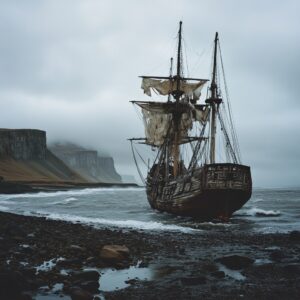
In early May of 1692, as Pettit’s crew made their petition against their destitute captain before the local counsel, a ghost ship was spotted mysteriously abandoned in an uninhabited bay without a soul on board. The guns and powder were still intact and it looked like the crew had fled quickly. Upon investigation it was identified as the pirate ship that had recently departed Rebellion Road. There were no other settlements in the area. The only place nearby they could have gone on land was Charles Towne. The city trembled as they realized that the pirate crew had silently infiltrated their town. The news spread like wildfire. There were rumors they had made it ashore with silver, gold, jewels, valuable artwork and other prizes from their escapades half a world away in the Red Sea. Some locals were suspected of being sympathetic to the pirates and were believed to be giving them safe refuge within the town. A proclamation was issued by the local government prohibiting anyone from harboring or concealing the pirates and ordering them to come forward.
Amidst this turbulence, William Pettit’s misfortune would take an astonishing turn. A few days after the Treple Crowne was wrecked and he was ordered to pay his angry crew, Captain William Pettit would step forward to claim ownership of the very pirate vessel the city had fearfully eyed. As these events converged in front of the counsel, William Pettit’s friendly association with the wealthy pirate captain, George Raynor, and his legendary crew would be purposefully disclosed. These daring buccaneers stepped out of the shadows, revealing themselves to those in charge of the colonial government. And when they spoke, they did so on behalf of Captain Pettit.
To understand why, we must look to the Caribbean and turn the clock back about two years to 1690.
A French Prize
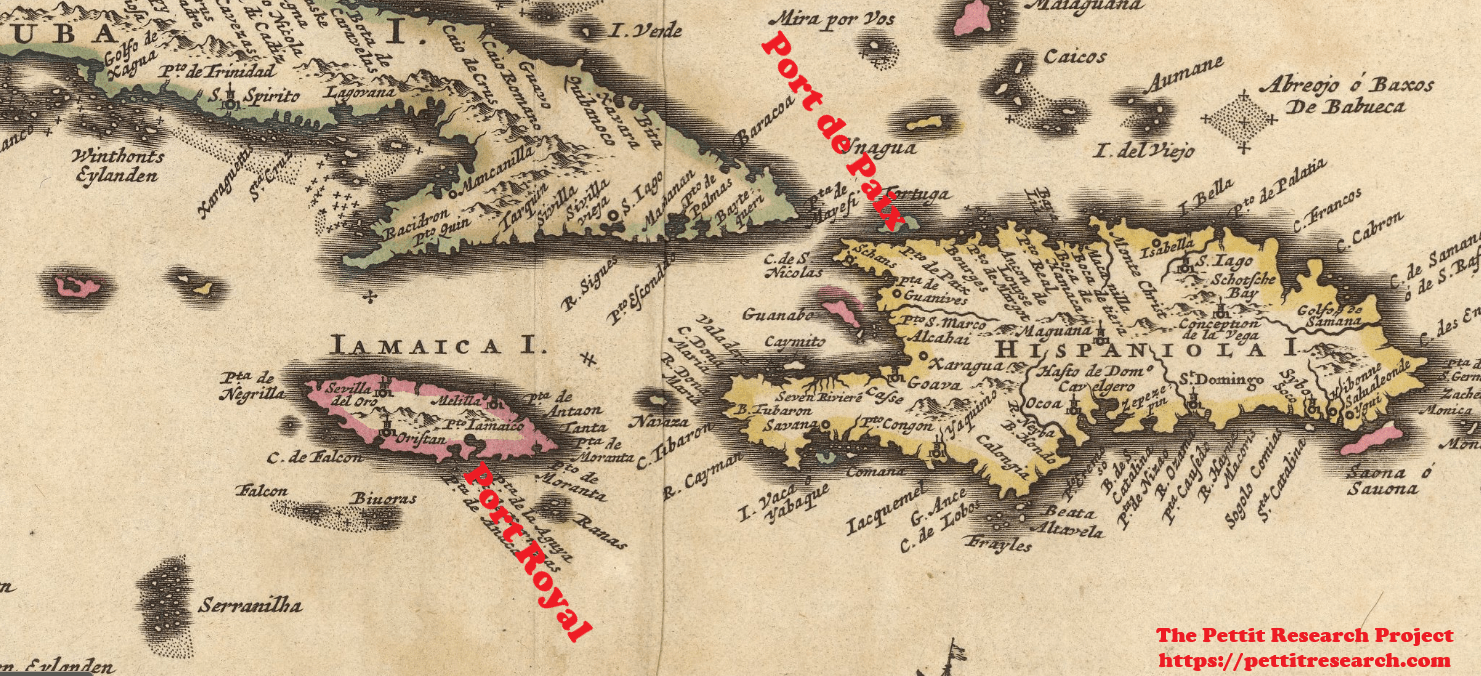
By 1690, the English colonial stronghold of Port Royal, Jamaica had gained the reputation of being the most wicked place in all the earth. It was often referred to as “the Sodom of the new world” and was filled with every type of debauchery known to man. English privateers operated out of this city and it eventually became the de facto capital of a privateer and pirate republic. Pirates found safe haven amongst other pirates in Port Royal. Tucked into a cove on the south side of the island, Port Royal was a bustling commercial center and naval station where the English held a court of admiralty dealing with maritime issues. It was here that records were kept that established letters of marque as well as ownership of captured ships. It was also from this location that a bold and perilous privateer raid into French territory was launched.
About 300 miles to the northeast, on the island of Hispaniola (modern day Haiti) was the French city known as Port-de-Paix. This name translates, somewhat ironically, to “Port of Peace” in English. Though not as scandalous as Port Royal, Jamaica, Port-de-Paix was also a safe harbor for privateers who operated under French colors. Port-de-Paix had a well fortified garrison and was teaming with privateer ships who were enemies of the English.
In March of 1690, two English privateer ships from Port Royal conducted a brazen mission in waters very near the French privateer stronghold at Port-de-Paix. The privateer sloop known as the Dyamond under the command of Captain Thomas Harrison, and the ship known as the Mary under the command of Captain George Auston came within sight of the “fort or castle of Port Apee [Port-dePaix] on north side of the island of Hispaniola.” There they encountered a 130-ton French ship known as La Constance. The Dyamond fired a shot her direction while the Mary “chased her, boarded and took her.” The story of La Constance’s capture comes from depositions of men who were among the English privateers who aided in her capture. Some others involved in this action besides the captains already mentioned were Henry Perry, Edmund Medlicott, Thomas Pickney, and George Raynor –the four men who would later testify in Charles Towne on behalf of William Pettit.
The Dymond and Mary escorted La Constance back to Port Royal. There the ship was condemned as a “French Prize” in the Court of Admiralty. Appropriate taxes were paid and it was sold to John Bell & Company of England. The French ship was renamed the Loyal Jamaica, outfitted with 14 cannons, and privateer Captain Thomas Harrison, formerly of the Dyamond, was given command. She sailed away from Port Royal on May 31, 1690, as an English privateer vessel belonging to John Bell & Company, but that status would quickly change.
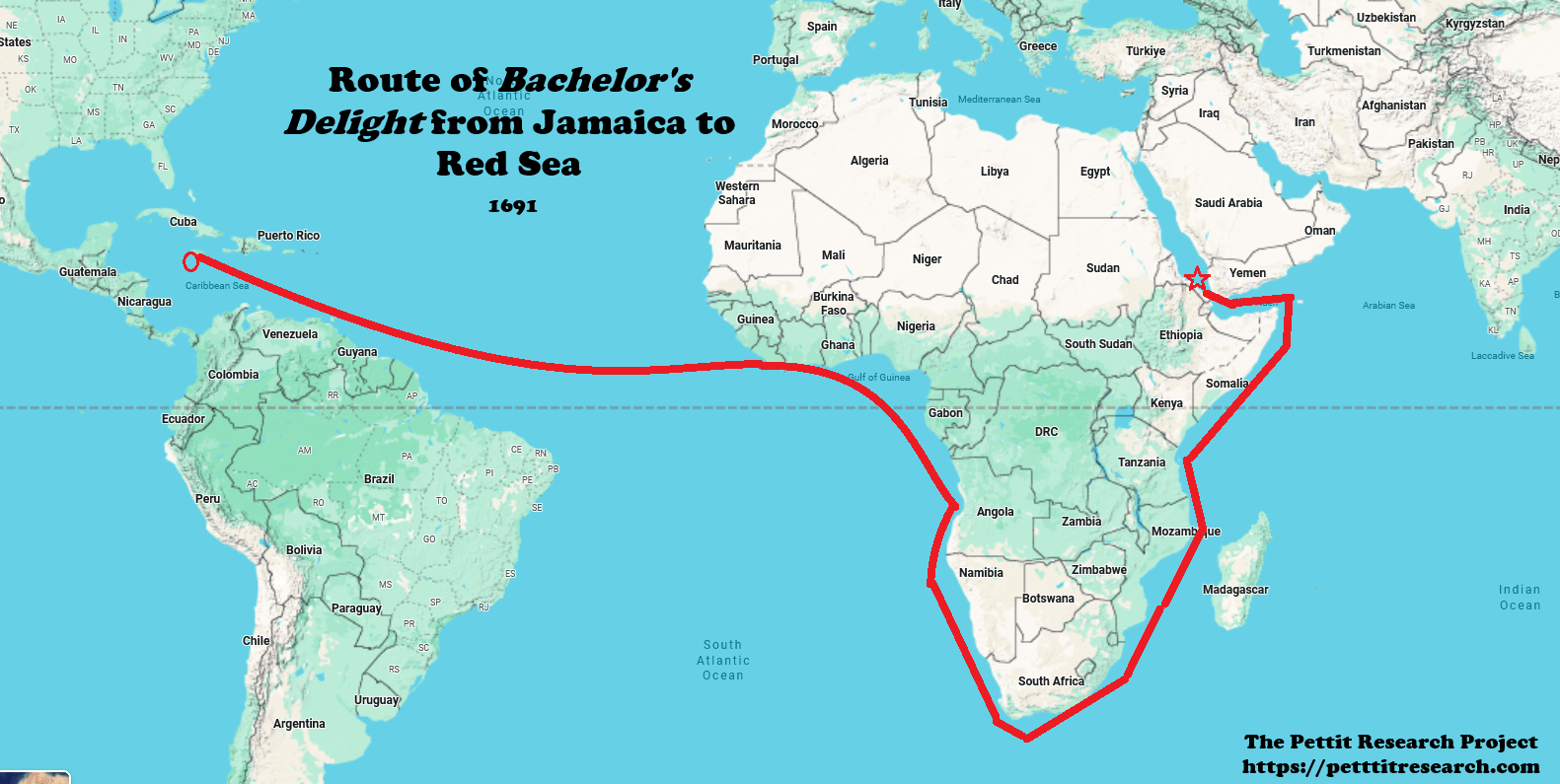
By October 15, 1690, Captain Thomas Harrison would find himself back on land in Jamaica while his ship, the Loyal Jamaica, sailed on without him. A mutiny had occurred and the crew decided to forsake their commissions as English privateers in favor of outright piracy. The Loyal Jamaica, was renamed the Bachelor’s Delight and a new captain, George Raynor, was elected by the crew. The Bachelor’s Delight set a course for thievery halfway across the globe and sailed east, leaving the turbulent Caribbean and the warring European countries far behind.
Red Sea Treasure
Over the next few months, Captain Raynor and his crew would navigate across the Atlantic Ocean and make their way to the western shore of Africa. From there they sailed south around the southern tip of the continent, then around to near Madagascar. Traversing the east coast of Africa, the Bachelor’s Delight finally reached its destination –the Red Sea. Though amazingly distant, their route was intentional and their terminus specific. What information they operated under that caused them to make this astounding journey of approximately 6,000 nautical miles is a historical mystery. One thing is for certain, however. Their gamble would pay off.
It was August of 1691 when the buccaneers entered the Red Sea through the strait of Bab-el Mandeb. Through this bottleneck heavy laden ships from the Mughal Empire carrying Muslim pilgrims to Mecca and massive fortunes from India to Yemen entered and exited the Red Sea. Some Mughal Empire vessels were filled with trade goods including gold, silver, jewelry, coinage, and valuable textiles. They were also poorly outfitted for warfare and totally unprepared for what the seasoned English pirates had to offer.
What happened next is best summarized in the book Arabian Gold by Adam Marrow:
In synopsis, gleaned from the reports, these English pirates assaulted a Mughal ship belonging to Abdul Ghafur on or around August 27, 1691, that had been traveling from the port of Mocah in the Red Sea bound for Surat, and crewed at least partially by Turks. The vessel had been laden with rich wares and treasure likely in excess of 100,000 rupees worth, or about 450,000 pieces of eight equivalent… The capture was no simple surrender; caving in to the pirates’ demands was preceded by much bloodshed resulting in twelve of the Mughal crew being killed, and another twenty having been wounding in some way. After the riches of the vessel had been plundered and relocated to the Bachelor’s Delight, they allowed the ship and her surviving crew to limp on to Surat.
Realizing they had just acquired the fortune of a lifetime, Captain Raynor decided it was time for an exodus from the Red Sea. The Bachelor’s Delight sailed to a safe harbor at Madagascar where the hull of the ship was careened and cleaned in preparation for its next long voyage. They would soon be headed back across the Atlantic with enough treasure for each man to retire in comfort, if they so desired.
Midway across the vast Atlantic Ocean, the crew spotted a signal in the distance. They changed course to investigate and stopped at a deserted isle known as Ascension Island. There they picked up two Danish castaways by the names of Peter Skroder and Cent Direckson. Departing this remote island, they continued on their way to South Carolina, stopping only occasionally to take on food and fresh water.
Back to Charles Towne
English privateers with proper papers would be allowed to approach Charles Towne. Pirates, on the other hand, were not welcome –at least not officially. Complicating things even further, the men on the Bachelor’s Delight were pirates who had stolen an English ship. They owed John Bell and Company for the ship, lost revenue and the broken privateering contract. They would have been considered dangerous rebellious enemies of the crown and could be tried and hanged. Captain Raynor knew all this, but he also knew the corrupt Governor of South Carolina, Seth Sothel, could be bought. Unfortunately for the crew of the Batchelor’s Delight, Governor Sothel who ruled the colony at the time the crew began its voyage had been removed from office just days prior to their return. Without the certainty of a sympathetic and corrupt government to bribe, their plan of quietly integrating into the southern colony with their massive fortune was in serious jeopardy. A simple check of the Court of Admiralty records at Port Royal, Jamaica, would instantly reveal the mutiny that occurred and the fact that these men were criminals in possession of a stolen English ship.
The pirates approached Charles Towne and came to a stop at Rebellion Road. They tarried there for a couple of days, weighing the limited options before them. Though no envoy was sent ashore, through communication with other ships, the town was informed that the captain of the ship was George Raynor. On April 13, 1692, they sent a letter addressed to him, asking him to enter the port legally or depart within 48 hours. No response was given and the ship eventually left.
Reports came in that the ship was still nearby, “hovering” around Sullivan Island. It was later found to be abandoned on April 23 at Sowee Bay near Bull’s Island. The pirates had taken their loot ashore and made it into the town. This would have been no easy task. Evading the authorities would be achievable in modern Charleston with a population of hundreds of thousands. In 1692, however, the estimated population was just over 1,000. The arrival of 30 or more pirates carrying literal tons of loot would not have gone unnoticed. So how did they pull it off? The savvy pirates shared their wealth with the people in charge of the levers of power and essentially bribed their way into the community. Treasure, it seems, can cover a multitude of sins.
On May 6, 1692, the Council issued a proclamation prohibiting the residents from concealing the pirates. It was sometime between May 6 and 11 that William Pettit’s crew ran the Treple Crowne aground. On May 11 members of Pettit’s crew sued him for eight-month wages. As this was taking place, the abandoned pirate ship was brought into the bay by orders of the Council. Two days later, on May 13, the Court of Admiralty met and condemned both the Treple Crowne and the pirate ship as wrecks confiscating their guns and powder for the public defense.
The next day, May 14, Captain George Raynor and his crew were required to come forward to be examined by the Council on the 26th of May. They were put under house arrest, prohibited from leaving for one year and local prominent citizens were required to give security bonds to assure these pirates would be good citizens and not flee. Many local men of renown who were involved in the politics and business of the colony put down good money to vouch for the pirates. John Alexander and William Smith put down £200 on behalf of Captain George Raynor. One wonders if they were really risking their own money, or if they had been given this bond and perhaps a little more for their troubles, out of the pirates’ treasure.
“Innocent” Privateers
Though the pirates had managed to successfully begin their integration into Charles Towne presenting themselves as legal privateers, there was still the matter of the stolen ship to deal with. The ship that was used in the Red Sea raid was the property of John Bell & Company. Should agents from John Bell discover the whereabouts of their ship and the location of the rebellious crew, they could demanded restitution and justice under English law. No doubt records of the mutiny and theft of this valuable vessel had been recorded by the Court of Admiralty in Port Royal, Jamaica. Though things were going smoothly for these wealthy pirates in South Carolina, there was simply no escaping the paper trail. It was only a matter of time until there would be a reckoning over the Loyal Jamaica a.k.a. Bachelor’s Delight. This would be true except that the “most wicked place on earth” was about to face a reckoning of its own.
At 11:43AM am on June 7, 1692, while George Raynor and his Red Sea pirates had been living peacefully for a month in Charles Towne, a cataclysmic disaster struck Port Royal. A massive earthquake rocked the entire island. It was so powerful that 2/3 of Port Royal sank into the ocean immediately. The entire town was flooded and the ships that were docked there were broken up and scattered throughout the remnants of the port. Buildings were crushed by waves, debris and vessels. Fortunately for the pirates living miles away in Charles Towne, the earthquake resulted in a massive record loss in Port Royal. Their history, as far as the stolen ship was concerned, was now a blank slate.
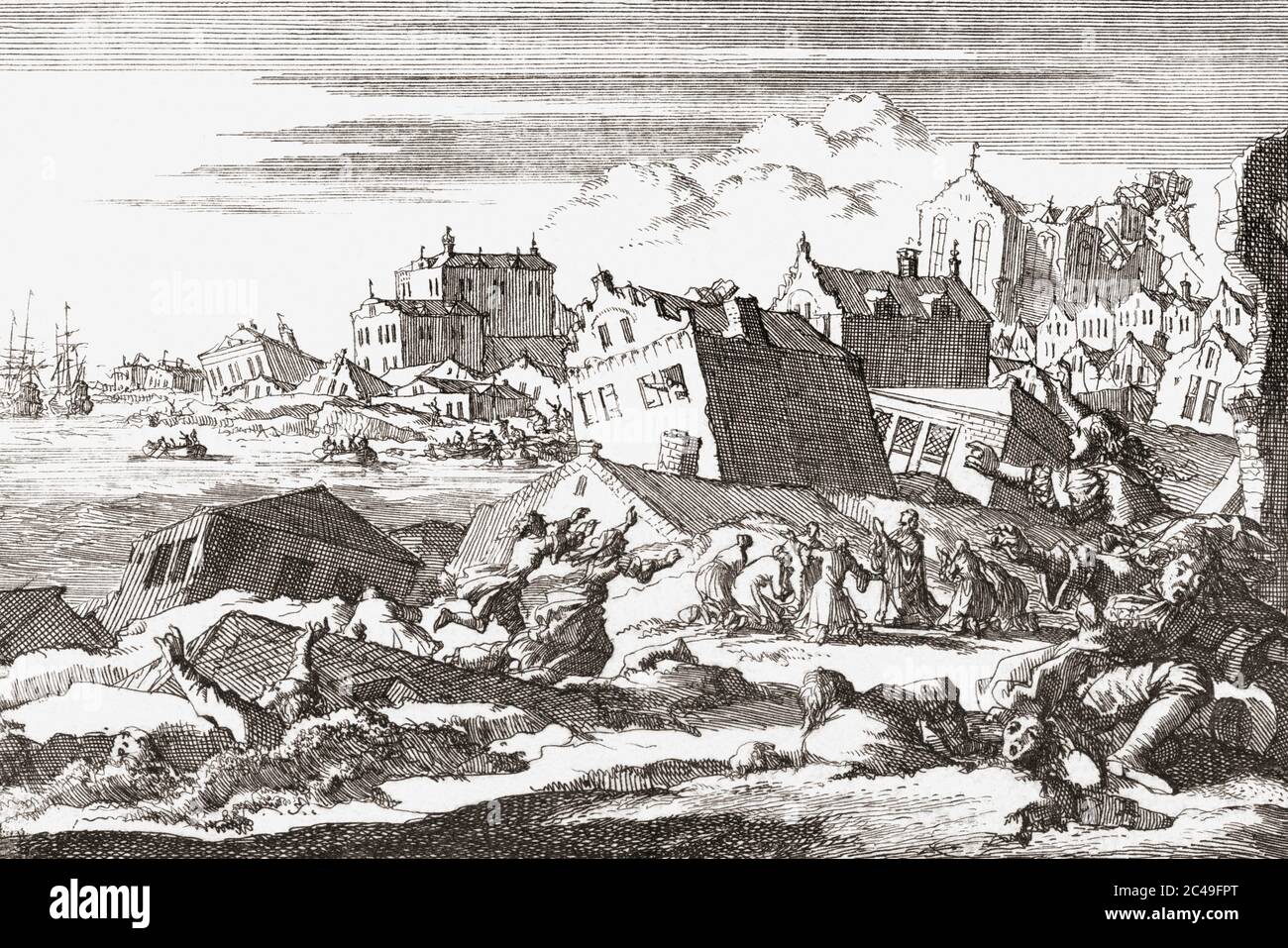
Though the exact sequence of events, and the obvious negotiations that took place outside of the court are not fully known, the pirates seized the opportunity to avail themselves of the remainder of their looming legal issues. From their collective Red Sea loot, the pirates paid off John Bell & Co for stealing and wrecking his ship. A generous sum of money, rumored to be about £3,000 was enough to quiet any claims the company had against them. After making things right with the commercial powers, the only remaining problem was the matter of their serious criminal violation of English piracy laws. Though they presented themselves as legal privateers, the fact remained that they sailed into Charles Towne in a known pirate ship. This was hard to simply ignore.
Though it was common knowledge, the proof of this fact was lost along with the rest of the records in the Jamaica earthquake. News of this disaster reached Charles Towne and, on August 22, 1692, the buccaneers made their final move. This brings us to their documented business involving Captain William Pettit.
Continued in Part II…