Nathan Pettit (b.1775) son of Joshua and Rachel Pettit of Spartanburg Co., SC Part I
Download the complete book for free from The Pettit Research Project:
 Nathan Pettit 1775-1855 of Spartanburg SC and Hancock, IL, Book.PDF
Currently Reading Part I
NATHAN PETTIT’S CHILDHOOD DURING THE AMERICAN REVOLUTION
In the year 1767, a man by the name of Joshua Pettit left his home in New Jersey, traveled up and over Virginia’s Shenandoah mountains, and settled his growing family on the wilds of the South Branch of the Potomac River.[1] It was in this area where he likely became acquainted with an infamous Indian trader from Winchester by the name of Richard Pearis. On at least one occasion the two would meet at an ordinary in Romney, Virginia.[2]
By the 1770s, Pearis, Jacob Hite, and several other Virginians were making arrangements to move to the forbidden lands west of the Indian boundary line in South Carolina.[3] In some way or another, this new settlement involved Joshua Pettit. In December of 1773, Joshua Pettit witnessed a massive land deal between Richard Pearis and the Cherokee head men in what would come to be present day Greenville, South Carolina.[4] The nature of Pettit’s business relationship with Pearis is not clear but he acquired 500 acres of land from him after the deed was finalized. He sold this land to a Virginian named John Armstrong sometime in 1775.[5] Joshua Pettit and his wife Rachel were likely either living on these former Cherokee lands or on Lawsons Fork of the Pacolet River in 96 District when their son Nathan, the subject of this writing, was born on September 12, 1775. [6],[7],[8] . When Nathan was not yet a year old, the Revolutionary War came roaring into the Carolina back country.
The Pettit family was residing on Lawsons Fork when war broke out in the summer of 1776.[9] A number of settlers in the surrounding area were slaughtered in a surprise attack by Cherokee warriors on the night of June 30, 1776. John Armstrong, who had moved onto the lands sold to him by Joshua Pettit, was among those who were murdered. Nathan, his pregnant mother, Rachel, and several of his siblings probably took refuge with the other settlers in the newly constructed Wofford’s Fort. This fort was built by his father Joshua Pettit under the command of Colonel William Wofford and supplied by Joseph Buffington.[10],[11] Joshua Pettit appears to have had some sort of association with Col. Wofford as he was in his company on other occasions as well.[12] Both Buffington and Wofford had a hand in operating the iron works on Lawsons Fork near where the Pettits lived for a time.[13] Some have speculated that Joshua Pettit was a skilled carpenter who helped Richard Pearis in the construction of his plantation buildings, William Wofford with his fort and iron works, and may have constructed his own mill near the Pacolet River. Evidence for this is scarce, but the theory is appealing.
In April of 1779, Nathan’s father recorded the birth of a daughter named Rachel in a small record book.[14] She was the last in a line of children that included Henry, Joshua Jr, Mary (died young), Benjamin, Nathan, John, Abraham, possibly a Hannah and maybe others who were older.[15]
Nathan grew up in back country South Carolina during its most savagely violent period. His older brother Henry Pettit, Sr., and father Joshua defended their homeland while in the Spartan Regiment under Colonel Benjamin Roebuck.[16],[17] Nathan would have been about five years old when the patriot troops under Brigadier General Thomas Sumter stopped by the Pettit farm for provisions. The Pettit family supplied them with beef from their herd.[18]

A depiction of the Siege of Charleston (1780) by Alonzo Chappel.
His brother Henry Pettit was wounded in the battle of Cowpens in January of 1781 and returned home to recover before re-enlisting to fight again. Numerous patriots in Nathan’s neighborhood were murdered at their homes when William “Bloody Bill” Cunningham set out on his “Bloody Scout” march in 1780.[19] Joshua Pettit was under Colonel Robert Anderson on the day Charleston fell into British hands on May 12, 1780.[20] Nathan saw the injury of his brother, watched the troops show up to his home to be fed, and heard the talk of the murder of nearby patriot men in front of their families. War was not some distant news story. It was there on his doorstep. He would have processed all this turmoil through the eyes of a young boy. It is impossible to know how this affected him but as an adult he certainly possessed the same relentless determination and drive displayed by his brother and father during The War for American Independence.
Nothing else is known about Nathan’s father after 1780 and he is presumed to have died not long after. He may have been a casualty of war or may have died after it ended. In any case, records indicate he was deceased prior to September 15, 1786.[21]
It is not known where Nathan and the other young siblings stayed after their father’s death, but it is not likely his mother Rachel could have managed the large family on her own. After the demise of his father, Nathan would not emerge on record until the year 1800 when he was an adult with his own family, living near his brother Joshua, Jr., on the Pacolet River.[22]
NATHAN PETTIT STARTS A FAMILY
Nathan married a woman named Levina whose maiden name has not been definitively identified.[23] Some online trees have her listed as a McCollugh or McCollum, but no solid corroborating source has been found for this. This theory most likely stems from the cautious research of Mel Brashears that may have been misused by other less diligent family historians. Mr. Brashears is a descendant of Nathan’s daughter Jemima Pettit Brashears and inherited a “Hap” McCollum’s Bible. He noted that this Bible was in Levina’s possession for reasons he did not know. This old Bible lists some McCollum children and would later be used by Nathan’s son-in-law Solomon Brashears to record the birth of his own children.[24],[25] Notwithstanding this fact, Mr. Brashears believed Levina was not a McCullum but suspected she may have been the daughter of a man named Jeremiah Clayton. Both the McCollum and the Clayton families lived near the Pettit and Brashears families in South Carolina. Either theory is possible. Mr. Brashears was careful not to declare his hypothesis as fact and neither has sufficient evidentiary support to be conclusive.
Assuming she was Nathan’s first and only wife, then they were most likely married sometime before their first child, Jemima Pettit, was born in 1797 in South Carolina.[26],[27],[28]
A few years later, in 1800, Nathan’s first and oldest son Thomas Pettit was born.[29],[30],[31] That year the census showed Nathan Pettit and presumably his wife living in Spartanburg County, South Carolina, with 1 male child (Thomas) and 1 female child (Jemima). He was living near his brother, Joshua Pettit, Jr., and was probably somewhere near the Pacolet River and the Healing Springs at Pooles bend.
A daughter, Rachel Pettit, was born in 1802.[32],[33] She may have been named in honor of Nathan’s mother. In 1803 another daughter, Keziah Pettit, entered the world.[34],[35],[36]
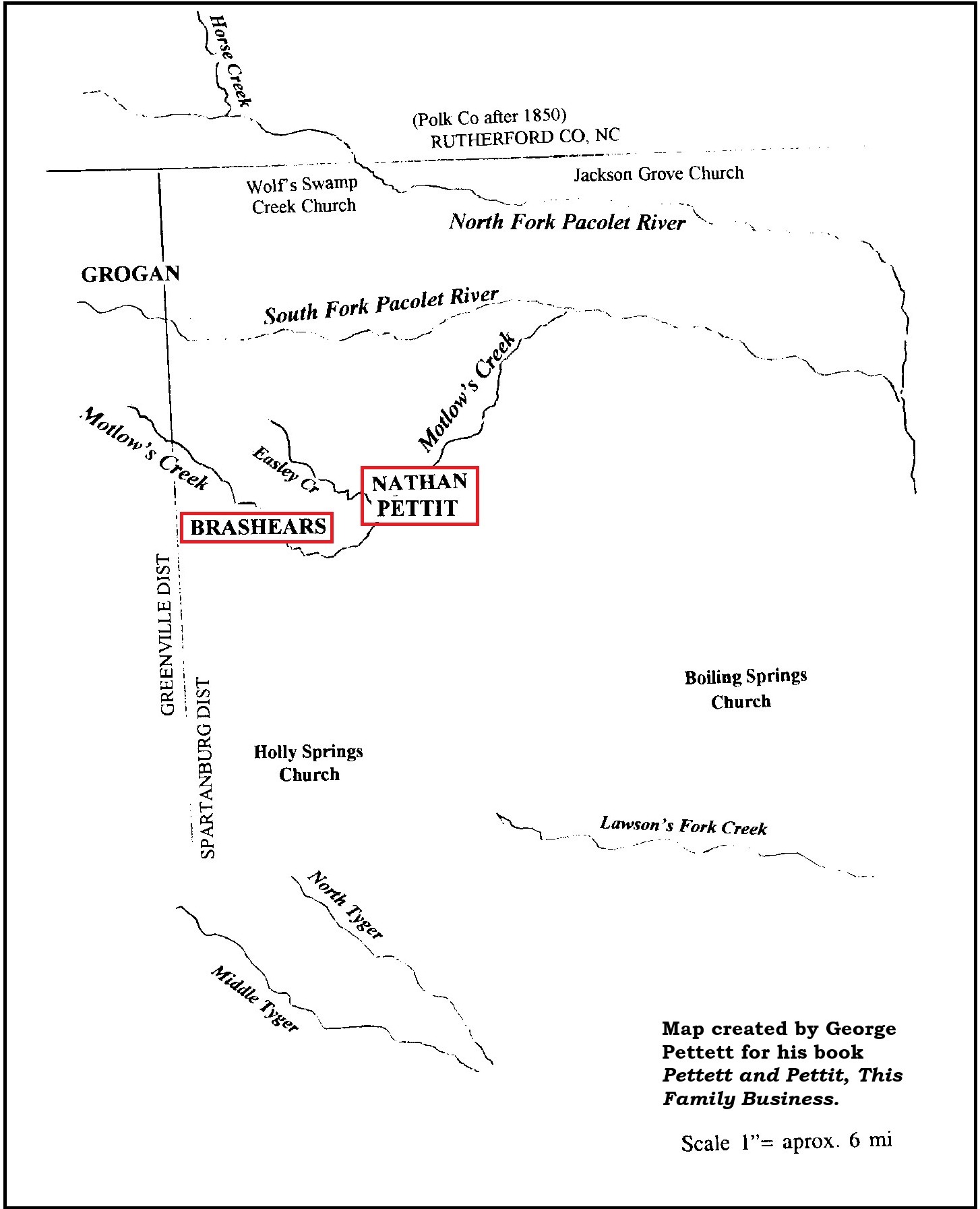
In 1805 a man who factored heavily into Nathan’s early life, William Brashears, obtained a grant for 966 acres in northwest Spartanburg County, near the Greenville County line.[37] The land was situated around Motlows Creek. William Brashears established his home there and set up a mill which was powered by the waters of the creek. By March of 1808, Nathan Pettit had relocated to the Motlows Creek area. He is mentioned that year as a neighbor in the deed of sale of fifty acres in the area from George Campbell to Samuel Fowler.[38] On September 25, of the same year Nathan Pettit along with William Brashears witnessed a deed between George Alexander and John Owens for land on both sides of Motlows Creek.[39]
In 1809 another daughter, Catherine Pettit, was born.[40],[41],[42] There is roughly a six-year gap between the births of Catherine and his previous child Keziah. Often a space of this nature between the births of children in this time period indicates pregnancy or birth complications.
The following year after Catherine’s birth, on February 19, 1810, Nathan Pettit became the owner of 250 acres of Motlows Creek land which he bought from Hugh Ewing.[43] This was a portion of the tract that was originally granted to John Clayton in 1785.[44],[45] In the same deed he also bought 20 acres adjoining this tract from Hugh Ewing which was part of a 1785 grant to Robert Goodgion.[46]
The 1810 Spartanburg census shows Nathan living near William Brashears. In Nathan’s home were: 1 female age 10-16 (Catherine), 3 females under 10 (Jemima, Rachel, Keziah), and 1 seriously outnumbered male child under the age of 10 (Thomas).[47]
In 1812, a second son was born and named after his father, Nathan Pettit, Jr.[48],[49] In 1814 the family welcomed another baby boy, John W. Pettit.[50],[51]
Nathan Pettit fathered another son in 1815 and named him Aaron Pettit.[52],[53] All evidence points towards his birthplace being South Carolina[54],[55] although the 1880 census strangely states he was born in Kentucky.
On December 10, 1816, Nathan became a grandfather. His oldest daughter Jemima Pettit had a baby of her own.[56] She had married Solomon Brashears, son of William Gowan Brashears.[57] The chosen name of their firstborn son was an interesting one apparently intended to honor Jemima’s grandfather: Joshua Pettit Brashears.[58]
On December 1, 1818, Nathan witnessed a land deed from John Sloan to James Loftis.[59] The land was on both sides of Holston Creek, of the South Pacolet River. Holston Creek feeds into Motlows Creek just before it enters the Pacolet. At least one Loftis family apparently set up residence somewhere near the Pettit family on Motlows Creek and the families would soon be intertwined.
The 1820 census of Spartanburg County shows only one Nathan Pettit but his age and those of his children do not align with those of the Nathan/Levina family.[60] This is his nephew, the son of Joshua Pettit, Jr. The absence of Nathan Pettit on the 1820 census is peculiar but may be due to him being enumerated under the wrong surname. Seven pages earlier, a Nathan “Pruatt” was recorded. The ages of the people in his household match perfectly with those that would be expected to be found in Nathan and Levina Pettit’s household. However, this is three pages and several names before the neighborhood where he is believed to have lived.
On that page where he would have been expected, page 41, Solomon Brashears and his family, including Jemima Pettit Brashears, were recorded. They were next to another Brashears whose first name is illegible. Next to Solomon is Samuel Fowler, the man whose 1808 land deed mentioned Nathan Pettit as a neighboring landowner. Next to Samuel Fowler is John J. Seay and next to him is a woman named Salley McCollum. Mrs. McCollum’s proximity to Jemima Pettit Brashears fuels speculation that there may indeed be a McCollum connection to the Pettit family.
Five years after their child Aaron was born, Nathan’s family welcomed one last child, Hannah Pettit, born in 1820.[61],[62] Nathan was about 45 years at the time, and his wife Levina was just a little younger than he.
Altogether, Nathan fathered the following children in South Carolina (birthdates approximate):
- Jemima 1797
- Thomas 1800
- Rachel 1802
- Keziah 1803
- Catherine 1809
- Joseph 1810
- Nathan 1812
- John W. 1814
- Aaron 1815
- Hannah 1820
In March of 1821, a Nathan Pettit was dismissed by Cedar Springs Baptist Church to help form Bethesda Church near Pooles Bend on the Pacolet River. He was ordained as a deacon along with Anthony Crocker, R. C. Pool, and James Haynes.[63] This could have been Nathan born 1775 or Nathan the son of Joshua, Jr., who would have been 29.[64] Oddly enough, neither man lived very close to the parent church they were dismissed from but Nathan, the son of Joshua Pettit and Judith Poole, was certainly the closer of the two.
The deed that Nathan Pettit witnessed in 1818 between John Sloan and James Loftis was presented to the Justice of the Peace in Spartanburg County by Nathan Pettit on February 18, 1823. Nathan gave the standard affidavit and signed with his mark. He, like most men of his day, could not write.
Nathan’s oldest son Thomas Pettit would marry a woman named Nancy and in October of 1828 she gave birth to a son, Austin Pettit, in South Carolina.[65],[66],[67],[68],
On January 13, 1829, Nathan sold his 225 acre tract of land on Motlows Creek to James Birchfield for $250 –the same price he paid for it nearly 19 years prior.[69] After disposing of his land, Nathan Pettit would set his eyes on the new turnpike that led northwest over the Blue Ridge Mountains and never grace the records of his Carolina home again.
THE NEW ROAD TO THE NEW FRONTIER
In 1828 the Buncombe Turnpike was completed.[70] This much needed road connected the Greenville, South Carolina area to the Tennessee/North Carolina line. Passing through the Saluda Gap in South Carolina and climbing to Asheville, travelers had a safe route that was a significant improvement over the old drover’s path. At his farm in northwestern Spartanburg County, Nathan Pettit may have encountered many travelers coming from distant points in the north and west. Places like Lexington, Kentucky and Cincinnati, Ohio could now be reached by wagon for Nathan. At least one member of the nearby Brashears family had already relocated to Ralls County, Missouri, by 1827.[71] There may have been others who migrated from the Motlows Creek neighborhood who returned with encouraging stories of the fertile lands in the west.
It is not clear what motivated Nathan Pettit to leave. He had lived in his Motlows Creek home for over twenty years. Ten children had been born there and now they were coming into adulthood and having children of their own. Perhaps Nathan assessed his place and realized it could not support subsequent generations of his family. Perhaps his crop land was played out and the untouched lands over the mountains enticed him.
The precise route chosen over the mountains is not known but can be estimated. Given his proximity to Greenville, it is probable that Nathan took the route north from Greenville to Asheville, North Carolina on the Buncombe Turnpike. From there the road would have taken them to Tennessee. Moving through Knoxville they would continue on to Lexington, Kentucky and eventually enter Cincinnati, Ohio from the south. Just north and west of Cincinnati was Butler County, Ohio –their first place of rest. It is said this was a popular staging area for people intending to go further west but it was also a nice place to settle down.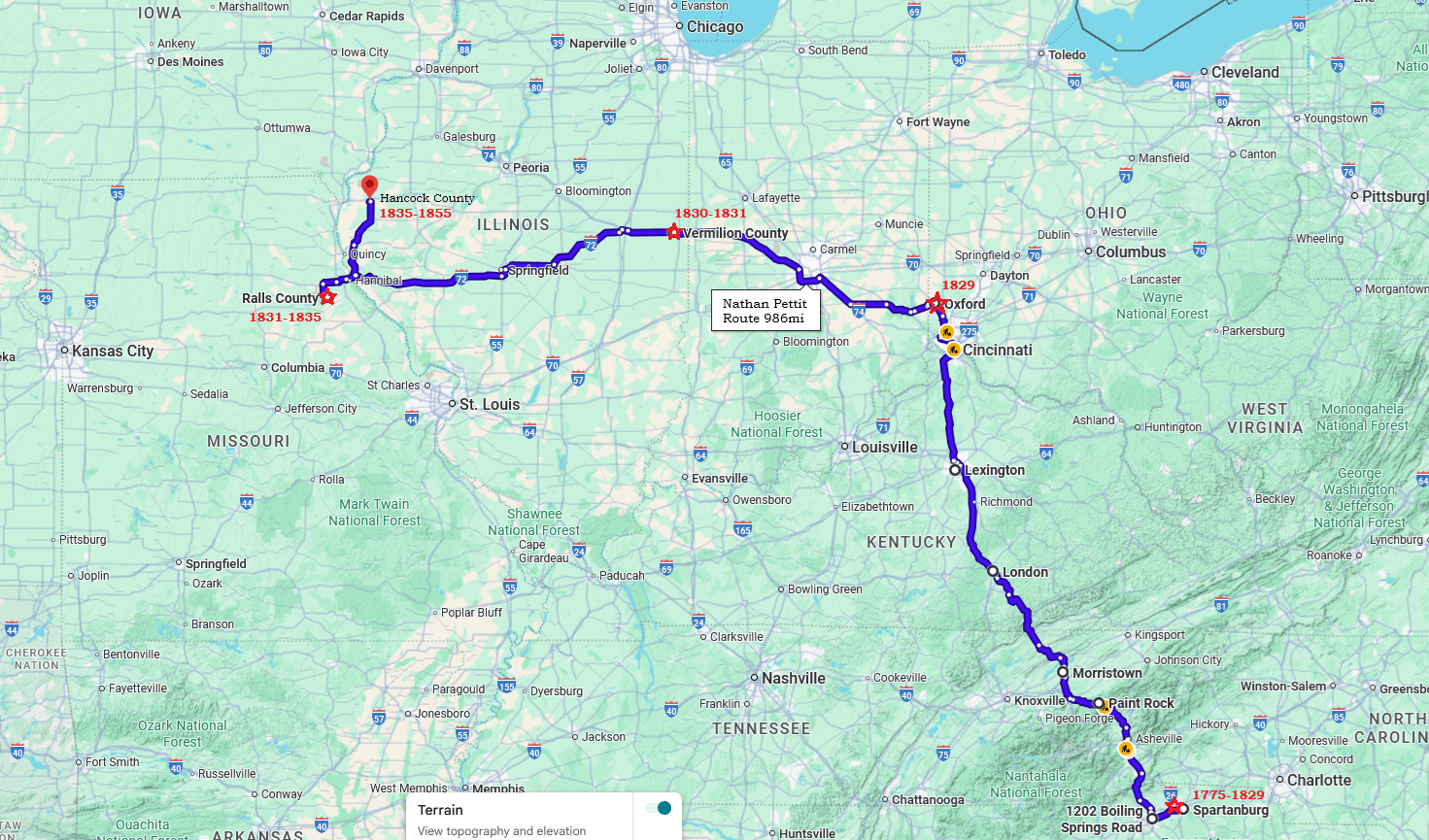
Depending on the method of transport, either ox or horse, and enumerable other factors, this trip would have likely taken well over a month. At the time of his departure in the spring of 1829, at least three of Nathan’s children were married. Thomas and his wife Nancy had a son named Austin who was just a few months old. Jemima was married to Solomon Brashears, and they had a quickly expanding family. Nathan’s daughter Catherine Pettit had married Hampton Loftis.
Family members likely in the caravan that departed South Carolina in 1829 included:
- Nathan Pettit and his wife Levina.
- Thomas Pettit, his wife Nancy and their 5-6 month old son Austin.
- Hampton Loftis and his wife Catherine Pettit who may have been pregnant.
- All the rest of Nathan’s children except Jemima Brashears. Their family remained in Spartanburg County for a brief time. They were enumerated there in the 1830 census.
- Possibly a William Pettit from Spartanburg County and his wife and at least two or three children.
By late spring of 1829, the party had made it from South Carolina to Butler County, Ohio. They rested there long enough to be counted by the tax assessor who made his rounds between March and May. That year Nathan Pettit appeared on the duplicate tax rolls for personal property in Butler County along with Thomas Pettit and a mysterious William Pettit.[72],[73] Nathan was taxed for five horses valued at $200 and one head of cattle. His son Thomas had one horse as did the nearby William Pettit. Nathan was recorded in the town of Oxford while Thomas and William appeared close by in the town of Milton. Oxford was already home to a school of higher education, Miami University, founded there in 1809. Though we do not know if Butler County was originally planned as their final destination or a place to rest and regroup, they probably stayed there through the winter of 1829-1830.
THE PETTIT HOME IN VERMILION COUNTY, ILLINOIS
By late spring of 1830, Nathan Pettit and company had pulled up stakes again and pushed about two hundred miles west into Vermilion County, Illinois.[74] Evidently, Thomas Pettit found some reason to remain behind in Milford with his wife and son. He, his wife Nancy, and son Austin are counted there in the 1830 census.[75] On May 24, 1830, Nathan Pettit and his wife Levina received a grant of 80 acres of land in Vermilion County, Illinois, in Section 32, Township 20 North, Range 12 West.[76]
By the time the census was conducted in August of 1830, Nathan had settled into the Oakwood area of Vermilion County and his son-in-law Hampton Loftis was enumerated next door.[77] Next to Loftis was a mysterious William Pettit who was much younger than Nathan but also not one of his children. The occupants of Nathan’s home and their recorded ages indicate he had two young children in his home that were not his. They may have been a grandson and granddaughter.
The United States Geological Survey land grid system was used to describe the location of Nathan’s property in the grant. From this it can easily be pinpointed on the map today. His parcel was about a mile and a half southeast of Newtown, Illinois, and was cut in two by the Middle Branch of the Vermilion River. An 1850 Vermilion County map notes that this area was covered in white oak forests.[78] It would have been thick with timber suitable for milling, and maybe good for some crops. Being in a basin and cut from north to south by a river, most of the land would have been subject to flooding. Nathan may have bought the property, sight unseen, or he may have had intentionally purchased this section of river for use as a power supply. At one point later in life, Nathan would call himself a miller and that may have been a skill he already possessed at this time. He had plenty of opportunities to have learned the trade before coming to Illinois.
When living on Motlows Creek in South Carolina his neighbor William Brashears operated Brashears Mill which was substantial enough to have made its way onto the 1825 Mills Atlas.[79] Nathan’s brothers Henry and Joshua operated a mill on Pettit’s branch of the Pacolet River while Nathan lived nearby.[80] There is evidence his brother John or one of his sons operated a mill on Pole Bridge Branch of the Pacolet.[81] Nathan’s son John W. was also listed as a miller on the 1870 census.[82] Suffice to say it is possible Nathan intended to set up a mill on this Oakwood, Illinois, property.
When Nathan settled this area, it was sparsely populated but quite perilous –not unlike the South Carolina of his childhood. Black Hawk, a chief of the Sauk and Fox Indians was displeased with previous treaties that ceded tribal lands and forced the nation to live west of the Mississippi River. Tensions between the US government and Black Hawk culminated with military action in 1831 in which volunteers burned deserted Indian villages on the east side of the river. By 1832, Illinois had raised a militia and engaged in what would become known as the Black Hawk War. Vermilion County supplied a company of mounted rangers to protect the settlers against raids.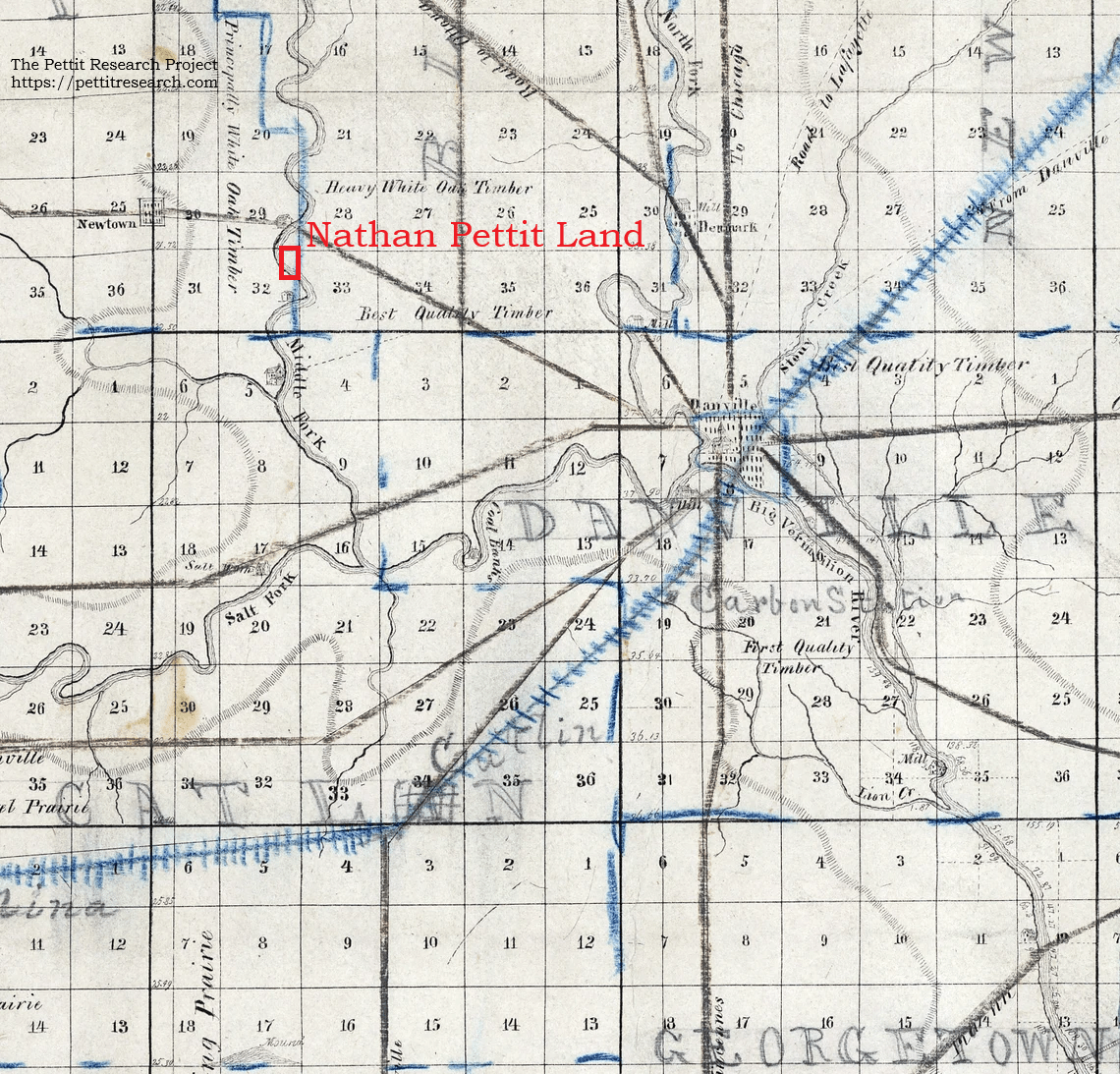
Though he probably never knew about it or had any use for it, many years later coal was discovered on Nathan’s property. The seams were shallow. Strip-mining operations deeply gouged out the land leaving open pits. After coal lost its marketability in the early 1900s the land was left scarred and mostly unusable. Eventually, the state of Illinois would come to possess it as well as hundreds of other acres of surrounding land. Today it has been repurposed as a wildlife refuge and nature preserve.
As Nathan and his family settled into their new home in eastern Illinois and eyed the Indian trouble brewing to the west, back in South Carolina his daughter Jemima and her husband Solomon Brashears had made the decision to move as well. An old Brashears family note says that Solomon Brashears with his family and his brother William Brashears departed South Carolina on November 15, 1830.[83] Their destination was Ralls County, Missouri. According to the note, they left from South Carolina in a wagon and made it just east of St. Louis to a place called Edwardsville, Illinois. There they would be stopped short of their goal, trapped by brutally harsh weather for four months.
“THE WINTER OF THE DEEP SNOW”
The weather in early 1829 had been favorable for the western migration of Nathan Pettit. The winter of 1829-1830 was mild. The fall of 1830 was also pleasant. As Nathan’s daughter Jemimah and her family set out for Missouri they no doubt prayed these good conditions would persist all the way to Ralls County. And indeed, they almost did. But as they approached Edwardsville, Illinois, and the Mississippi River was almost within sight, a cold rain began to fall.
From December 20 to Christmas Eve of 1830 the icy rain continued to pelt the area. Then from December 29-31 a three-day snowstorm in the region dumped 3-4 feet of snow. A roaring wind created snow drifts 15-20 feet high. The storm was followed by an ice storm that left a layer of ice on top thick enough “to bear a man.”[84] This was capped off with another four or more inches of snow. On January 1, 1831, the temperature in the area fell to -15 degrees. Snow continued for the rest of January with the temperature remaining below freezing on all but five days. Another blizzard blanketed the area on February 2, 1831.
Food became scarce. Livestock froze. There were reports of turkeys freezing to death while roosting in trees. Deer were unable to forage in the deep snow and died. Wolves preyed on the struggling animals. Some settlers disappeared and their bodies were not discovered until the snow melted in the spring.
While the Brashears family was forced to ride out the winter in Edwardsville, Nathan Pettit and his family experienced similar conditions at his new home in Oakwood, Illinois. It was not until February 21 that the weather relented with a high temperature reaching a much-welcomed 39 degrees.
On May 1, 1831, Solomon Brashears and his family crossed the mighty Mississippi River at Alton, Illinois, and made their way north to Ralls County, Missouri.[85] They settled five miles west of New London on a heavily wooded tract of land by the Salt River.[86] Just fifteen days later, on May 16, Nathan Pettit’s land in Vermilion County, Illinois, was officially patented and he did not delay in disposing of it.
After spending just over a year on their new homestead, on September 21, 1831, Nathan and his wife Levina sold their Illinois land to neighboring landowner Henry Shockey.[87] Nathan pocketed $250 for this 80-acre tract –the same price he received for his 225 acres in Spartanburg County in 1829. Both Nathan and Levina were present in Vermilion County to sign the deed with their marks before the Justice of the Peace. Sometime shortly after this, Nathan and his family moved to Missouri to live near his son-in-law Solomon Brashears.
The families were reunited and were able to enjoy each other’s company in Ralls County for a few years before Levina Pettit was taken away from them. Someone made a note in the family Bible of Solomon Brashears that stated, “Mother Pettit died on December 20, 1834”.[88] That following spring, in 1835, Nathan, now a widower, was stirred once more to uproot his family and move.[89]
The Mississippi River that formed the border between Missouri and Illinois was about fifteen miles to the east of the Brashears homestead. Nathan settled in a place approximately forty-five miles upriver and on the opposite side. He made his new home in a place called Rocky Run in Hancock County, Illinois. There, at the age of sixty, he would set up a farm and a mill on a small creek with no name.
SOURCES
- “From Virginia: The Pettit Family of Spartanburg Co., SC”, The Pettit Research Project, October 2018, https://pettitresearch.com/familyhistory/2020/08/19/from-virginia-the-pettit-family-of-spartanburg-co-sc/ ↑
- Ibid. ↑
- Ibid. ↑
- Oconostotah, Willinawauh, and Ewe Three Head Men of the Cherokee to George Pearis of said Cherokee Nation, Dec. 21, 1773, South Carolina Public Register, Conveyance Books, Series ST158, Book 5E, p502-505, South Carolina Department of Archives and History. ↑
- Petition of Ann Armstrong, 1784, South Carolina General Assembly Committee Reports, South Carolina Department of Archives and History, S165005, 1784, No. 6. ↑
- 1850 U.S. Census, Hancock County, IL, population schedule, p. 364, dwelling 1355, family 1357, Nathan Pettit; NARA microfilm publication M432, Roll 109, National Archives Records Administration, Washington D.C. ↑
- 1880 U.S. Census, Big Creek Township, Taney County, Missouri, population schedule, enumeration district 125, p. 281, dwelling 81, family 81, John W. Pettit; NARA microfilm publication T9, Roll 738, National Archives and Records Administration, Washington D.C; father’s birthplace listed as South Carolina. ↑
- “Examining the Henry Pettit Sr. Family Bible Record and the Record of his Father Joshua Pettit (as preserved in the National Archives)”, The Pettit Research Project, February 2, 2019, https://pettitresearch.com/familyhistory/2020/08/26/examining-the-henry-pettit-sr-family-bible-record-and-the-record-of-his-father-joshua-pettit-as-preserved-in-the-national-archives/; An entry that probably corresponds to his birth can be found in the Bible record of his brother Henry Pettit, Sr that is in the National Archives in Washington, D.C. ↑
- Revolutionary War Pension and Bounty-Land Warrant Application Files, Henry Pettit #W5528, National Archives Microfilm Publication M804, National Archives and Records Administration (NARA), Washington D.C. ↑
- Ibid. ↑
- “Joseph Buffington,” A.S. Salley, Accounts Audited of Claims Growing out of the Revolution in South Carolina, (Columbia, SC: Historical Commission of South Carolina by the State company, 1935-) AA 883, Roll 16, p59. ↑
- John Nuckols to William Wofford Deed, Charleston Deeds, 1719-1776, South Carolina Department of Archives and History, S372001, Vol B-5, p364-5; Joshua Pettit was a witness to this deed. ↑
- Brooks, Jim S. “The Ironworks on Lawsons Fork.” Electronic document, https://glendalesc.com/ironworks.pdf , accessed January 27, 2026. ↑
- Examining the Henry Pettit Sr. Family Bible Record,” The Pettit Research Project, Ibid. ↑
- “The Full List of Children of Joshua and Rachel Pettit of Spartanburg County, SC Based on the Best Supporting Documentation Available,” The Pettit Research Project, Accessed 2 February 2026, https://pettitresearch.com/familyhistory/2021/01/02/the-full-list-of-children-of-joshua-pettit-b1734-and-rachel-pettit-of-spartanburg-sc-based-on-the-best-supporting-documentation-available/ ↑
- “Joshua Pettit,” A.S. Salley, Accounts Audited of Claims Growing out of the Revolution in South Carolina, (Columbia, SC: Historical Commission of South Carolina by the State company, 1935-) AA 5901, Roll 117, p427-428. ↑
- “Henry Pettit,” A.S. Salley, Accounts Audited of Claims Growing out of the Revolution in South Carolina, (Columbia, SC: Historical Commission of South Carolina by the State company, 1935-) AA 5900, Roll 117, p412-423. ↑
- Ibid. ↑
- John C. Parker., Jr, Parker’s Guide to the Revolutionary War in South Carolina, (West Conshohocken, PA, 2013), pp. 4,6,23,158,292,293,296,298,299-301,305,315,319,336,341-3,348,350,351,319,336,341-343,348,350,351,367,373,386,387,393,397,406-409,423,424,426,427,429,481,406-408. ↑
- Joshua Pettit,” A.S. Salley, Accounts Audited, SCDAH, ibid. ↑
- “The Death of Old Joshua Pettit of Spartanburg Co., SC 1780~1786,” The Pettit Research Project, November 27, 2022, https://pettitresearch.com/familyhistory/2022/11/27/the-death-of-old-joshua-pettit-of-spartanburg-co-sc-1786/. ↑
- 1800 U.S. Census, Spartanburg County, South Carolina, population schedule, p. 206, line 19, household of Nathan Pettit; NARA microfilm publication M32, Roll 50, National Archives and Records Administration, Washington D.C ↑
- Vermilion County, Illinois, Deed Book A: 447, Nathan Pettit and Levina Pettit to Henry Shockey, 21 September 1831, Vermilion County Recorder, Danville, Illinois ↑
- See Appendix -Solomon Brashears and Hap McCollum Family Bible ↑
- Mel Brashears, email message to Brandon Pettit, December 4, 2020. Mel Brashears stated: “Recall, I have in my possession, a McCollum Bible that Levina took with her to Missouri and Solomon Brashears used for his children’s birth records after her death in 1838 in Ralls County.” ↑
- 1800 U.S. Census, Spartanburg County, South Carolina, household of Nathan Pettit, ibid. ↑
- 1850 U.S. Census, Ralls County, Missouri, population schedule, Enumeration district 73, p.164, dwelling 356, family 361, line 38, household of Solomon Brashears; NARA microfilm publication M432, Roll 411, National Archives and Records Administration, Washington D.C ↑
- Hancock County, Illinois probate records, ca. 1831-1942; Author: Hancock County (Illinois). Clerk of the Circuit Court; Probate Place: Hancock, Illinois Description Notes: Probate records, Boxes 35-36, 1850s-1860s, pp. 1-112, Nathan Pettit ↑
- 1800 Census 1800 U.S. Census, Spartanburg County, South Carolina, household of Nathan Pettit, ibid. ↑
- 1830 U.S. Census, Butler County, Ohio, population schedule, Milford, p.127 (handwritten), line 21, household of Thomas Pettit; NARA microfilm publication M19, Roll 127, National Archives and Records Administration, Washington D.C. ↑
- Hancock County, Illinois probate record, Nathan Pettit, Ibid. ↑
- 1810 U.S. Census, Spartanburg County, South Carolina, population schedule, p. 182B, line 31, household of Nathan Pettit; NARA microfilm publication M252, Roll 61, National Archives and Records Administration, Washington D.C ↑
- Hancock County, Illinois probate record, Nathan Pettit, Ibid. ↑
- 1810 U.S. Census, Spartanburg County, SC, ibid. ↑
- 1850 U.S. Census, Hancock County, Illinois, population schedule, Enumeration district 27, p.364A, dwelling 1355, family 1357, line 17, household of Nathan Pettit NARA microfilm publication M432, Roll 109, National Archives and Records Administration, Washington D.C ↑
- Hancock County, Illinois probate record, Nathan Pettit, Ibid. ↑
- William Beshears, Plat for 966 Acres on Motlows Creek and South Pacolet River, Spartanburg District, State Plat Books (Columbia Series (S213192), Vol 39, p. 455, Item 1, South Carolina Department of Archives and History. ↑
- Spartanburg Deeds, Book M, pp. 385-386, Roll C603, South Carolina Department of Archives and History ↑
- Spartanburg Deeds, Book O, p. 78, Roll C604, South Carolina Department of Archives and History ↑
- 1810 U.S. Census, Spartanburg County, SC, ibid. ↑
- 1840 U.S. Census, Hancock County, Illinois, population schedule, p 222A, line 15, household of Hampton Loftis; NARA microfilm publication M704, Roll 60, National Archives and Records Administration, Washington D.C. ↑
- Hancock County, Illinois probate record, Nathan Pettit, Ibid. ↑
- Spartanburg Deeds, Book P, pp. 54-55, Roll C604, South Carolina Department of Archives and History ↑
- Ibid. ↑
- John Clayton, Plat For 255 Acres on Mottleys Creek, Ninety-Six District, State Plat Books (Columbia Series (S213190), Vol 4, p. 241, South Carolina Department of Archives and History. ↑
- Robert Goodgion, Plat for 491 Acres on Mottlow Creek, Ninety Six District, State Plat Books (Columbia Series (S213190), Vol 1, p 175, South Carolina Department of Archives and History.Note that the deed says this grant occurred on June 6, 1785, but the grant is dated November 10, 1784. ↑
- 1810 U.S. Census, Spartanburg County, SC, ibid. ↑
- 1850 U.S. Census, Hancock County, IL, ibid. ↑
- Hancock County, Illinois probate record, Nathan Pettit, Ibid. ↑
- 1870 U.S. Census, Sullivan County, Missouri, population schedule, Liberty Township, p. 19, dwelling 127, family 127, line 2, household of John Pettit NARA microfilm publication M593, Roll 822, National Archives and Records Administration, Washington D.C. ↑
- Hancock County, Illinois probate record, Nathan Pettit, Ibid. ↑
- 1880 U.S. Census, Hancock County, Illinois, population schedule, Rocky Run Township, p. 6B, enumeration district (ED) 79, family 50, Aaron. Pettit; NARA microfilm publication T9, Roll211 NARA, Washington D.C. ↑
- Hancock County, Illinois probate record, Nathan Pettit, Ibid. ↑
- 1860 U.S. Census, Knox County, Missouri, population schedule, Edina, p. 127, dwelling 915, family 888, line 26, household of Aaron Pettit, NARA microfilm publication M653, Roll 627, National Archives and Records Administration, Washington D.C. ↑
- 1900 U.S. Census, Hancock County, Illinois, population schedule, Warsaw Township, Enumeration district 17, p. 325A, dwelling 269, family 277, line 47, household of Ellen Burch, NARA microfilm publication T623, Roll 305, NARA, Washington D.C.Hancock County, Illinois probate record, Nathan Pettit, Ibid. ↑
- Find A Grave, database and images (https://www.findagrave.com/memorial/48185924/joshua_pettit-brashears : accessed 1 January 2026), memorial page for Joshua Pettit Brashears (10 Dec 1816–18 Jan 1879), Find A Grave Memorial no. 48185924, citing Bethel Baptist Church Cemetery, New London, Ralls County, Missouri. Maintained by Anne Wagner; Birth date shown on gravestone. ↑
- Spartanburg Deeds, Book CC, pp. 284-285, South Carolina Department of Archives and History; Solomon Beshears gave John Wood power of attorney to sell 100 acres “willed to me by my father”. Property conveyed was William Brashears’ land on Motlows Creek. Signed by Solomon Brashears and Jemima Brashears. ↑
- See Appendix -Solomon Brashears and Hap McCollum Family Bible; Family Bible of Solomon Brashears and Jemimah Pettit (1797-1857), privately held by Mel Brashears, San Jose, California. ↑
- Spartanburg Deeds, Book U, pp. 440-441, Roll C606, South Carolina Department of Archives and History. ↑
- 1820 U.S. Census, Spartanburg County, South Carolina, population schedule, p. 440B, line 6, household of Nathan Pettit; NARA microfilm publication M33, Roll 120, National Archives and Records Administration, Washington D.C. ↑
- 1860 U.S. Census, Marion County, Missouri, population schedule, Round Grove Township, p. 53, dwelling 372, family 364, line 26, household of William H. Martin, NARA microfilm publication M653, Roll 633, National Archives and Records Administration, Washington D.C. ↑
- Hancock County, Illinois probate record, Nathan Pettit, ibid. ↑
- Bethesda Baptist Church, Spartanburg County; Inventory of Church Archives, Works Progress Administration Survey of State and Local Historical Records, Taylor, Jean L.; Manuscripts Division, South Carolinian Library, University of South Carolina, Columbia, p. 2. ↑
- 1870 U.S. Census, Calhoun County, Alabama, population schedule, Election Precinct 6, Peeks Hill, p. 4, dwelling 22, family 22, line 1, household of Nathan Pettit NARA microfilm publication M593, Roll 822, NARA, Washington D.C. ↑
- Hancock County, Illinois probate record, Nathan Pettit, ibid; Mistakenly called “Oscar” instead of Austin. ↑
- Hancock County (Illinois), Office of the Circuit Clerk, Carthage, Illinois, Chancery Records, Volume F, 1857-1859, Family History Library Film 955136, Roll 53, Image Group 8566288, Item 1, Filmed 12 Mar 1974, pp. 125, 149; images, FamilySearch (https://www.familysearch.org/ark:/61903/3:1:3Q9M-C3QY-4S64-T). ↑
- 1850 U.S. Census, Butler County, Ohio, population schedule, Oxford Township, p. 445, household 803, family 838, line 14, household of Nancy VanHorn, NARA microfilm publication M432, roll 663, National Archives and Records Administration, Washington D.C.; Nancy VanHorn was Thomas Pettit’s widow who married James VanHorn. James had also died by the time of the 1850 census. ↑
- 1880 U.S. Census, Pike County, Illinois, population schedule, Atlas Township, Enumeration district 179, p. 16, dwelling 129, family 132, Aaron Pettit, NARA microfilm publication T9, Roll 244 National Archives and Records Administration, Washington D.C. ↑
- Spartanburg Deeds, Conveyance Book V, pp. 88-89, Roll C606, South Carolina Department of Archives and History. ↑
- “The Buncombe Turnpike,” A North Carolina History Online Resource, 2004, https://www.ncpedia.org/anchor/buncombe-turnpike ↑
- Walter Williams, A History of Northwest Missouri, Volume 3 (Chicago: The Lewis Publishing Company, 1915), p. 1991; Thomas Alexander Brashear biography. ↑
- Tax Record Butler County (Ohio), Ohio Historical Society Library in Franklin County, Auditor of the State, Volume 161, Year 1829, Family History Library Film 514156, Roll 1900, Filmed 28 Dec 1966, p. 472, images, Image Group 4849016, FamilySearch (https://www.familysearch.org/ark:/61903/3:1:33S7-9PP6-SB2); Entry for Nathan Pettit. ↑
- Tax Record Butler County (Ohio), Ohio Historical Society Library in Franklin County, Auditor of the State, Volume 161, Year 1829, Family History Library Film 514156, Roll 1900, Filmed 28 Dec 1966, p. 459, images, Image Group 4849016, FamilySearch (https://www.familysearch.org/ark:/61903/3:1:33SQ-GPP6-3FB); Entries for William Pettit and Thomas Pettit. ↑
- 1830 U.S. Census, Vermilion County, Illinois, population schedule, p. 224, line 26, household of Nathan Pettit, NARA microfilm publication M19, Roll 25, National Archives and Records Administration, Washington D.C. ↑
- 1830 U.S. Census, Butler County, Ohio, population schedule, Milford Township, p. 127, line 21, household of Thomas Pettit, NARA microfilm publication M19, Roll 126, National Archives and Records Administration, Washington D.C. ↑
- Nathan Pettit (Vermilion County, Illinois) homestead patent no 1914. (16 May 1831), General Land Office Records, Accession Nr IL0360__.422, US Department of the Interior, Bureau of Land Management. ↑
- “Charlotte A. Volkel et al., Tax and Land Records, Vermilion County, State of Illinois, (Danville: Illiana Genealogical Publishing Company, n.d.), p. 45.; “Pettit, Nathan oak 30”. ↑
- American Geographical Society Library Digital Map Collection, “Map of Vermilion County, Ills. & Ind. / compiled 1850 by John Wilson survr. from the United States Survey, Klauprech & Menzel’s Lith,” Accessed July 18, 2025, https://collections.lib.uwm.edu/digital/collection/agdm/id/21117 ↑
- South Carolina Digital Library, “Atlas of the State of South Carolina by Robert Mills,” Accessed February 25, 2026, https://digital.tcl.sc.edu/digital/collection/rma/id/100/rec/1 ↑
- Joshua Pettit Will, Spartanburg District, SC., South Carolina Will Transcripts, Microcopy No. 9, Series S108093, Reel 0024, Frame 00287, (Will Book B, Page 136, February 15, 1828), S.C. Department of Archives and History. ↑
- Spartanburg Deeds, Book MM 1874-1876, p. 196, South Carolina Department of Archives and History; Deed of sale for Aaron Templeman to W. M. Foster describes Nathan Pettit’s (son of John 1771) line to the mill pond. ↑
- 1870 U.S. Census, Sullivan County, MO, household of John Pettit, ibid. ↑
- Mel Brashears, “Note Found in Sarah Jo’s Files Written by Some Unknown Member of the Family” Handwritten note, No Date, Personal Files of Mel Brashears, San Jose, CA 95138; Per Mel: this note may have been written by Aunt Ella Brashears Kerr (granddaughter of Jemima Pettit). Note reads in part, “Solomon Brashears with his family left South Carolina, Nov 15, 1830 (their twins Uncle Doc & Uncle Bill being one year old that day) & came through in a wagon -landed in Edwardsville -Illinois in the fall when a snow (three feet) fell & they remained there all winter…” ↑
- “The Deep Snow,” The Illinois Intelligencer, January 28, 1968. ↑
- Mel Brashears, “Note Found in Sarah Jo’s Files,” Ibid. ↑
- Henry Sinclair Brashear, The Brashear–Brashears Family 1449-1929 (Texarkana, Arkansas-Texas: Self-published, 1929), pp 93-94. ↑
- Vermilion County, Illinois, Deed Book A: 447, Nathan Pettit and Levina Pettit to Henry Shockey, 21 September 1831, Vermilion County Recorder, Danville. ↑
- See Appendix -Solomon Brashears and Hap McCollum Family Bible. ↑
- Hancock County, Illinois probate record, Nathan Pettit, ibid; “Aaron Pettit. In 1835 we moved to this county…” ↑