Capt William Pettit: A 1690s Carolina Mariner and His Ties to Infamous Pirates Part 2
Continued from Part I
Click here to read Part I and the story of the Red Sea raid.
The Carolina Merchant
At the same time Captain William Pettit’s ship was determined to be a total loss and his crew was suing him for their wages, the pirate ship was condemned as a wreck and brought into the harbor by order of the Court. He may have been part of a scheme of sorts involving the Public Treasurer, and merchant Jonathan Amory, as well as pirate Captain George Raynor.
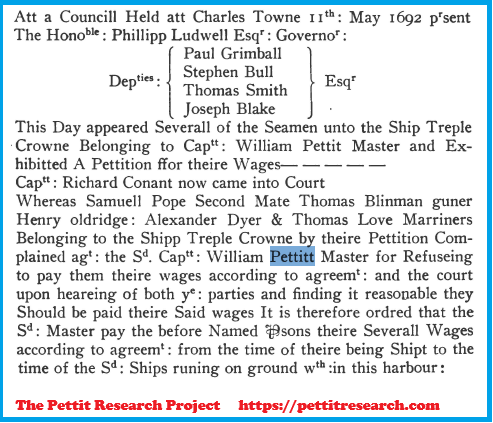
JOURNAL OF THE Grand Council OF SOUTH CAROLINA April 11, 1692-. September 26,1692 Edited by A. S. SALLEY, JR.
On August 22, Captain William Pettit was deemed to be the proud owner of the pirate ship, now called the Carolina Merchant. The record reveals that a bill of sale or conveyance was given to Pettit by the Court of Admiralty after it was condemned as a wreck. The order to condemn the ship undoubtedly involved the Public Treasurer, Jonathan Amory. Amory was not just the treasurer. He was also the Advocate-General (the chief maritime lawyer) for the Court. He would benefit from Pettit’s acquisition in short order. With the ship being sold by the Court instead of directly by Raynor, it was effectively legally “laundered.” To establish a clear title for the stolen pirate ship and wash it of any piracy suspicions, four pirates testified about its origin for Captain William Pettit.
Henry Perry, Thomas Pinkney, Edmond Medlicut, and Captain George Reynor gave depositions in which they stated the ship was originally a French prize taken lawfully in 1690 while they were English privateers. They mentioned that it was brought back to Port Royal and sold to John Bell & Co. Of course, they neglected to mention the mutiny and the excursion into the Red Sea, and nobody bothered to ask.
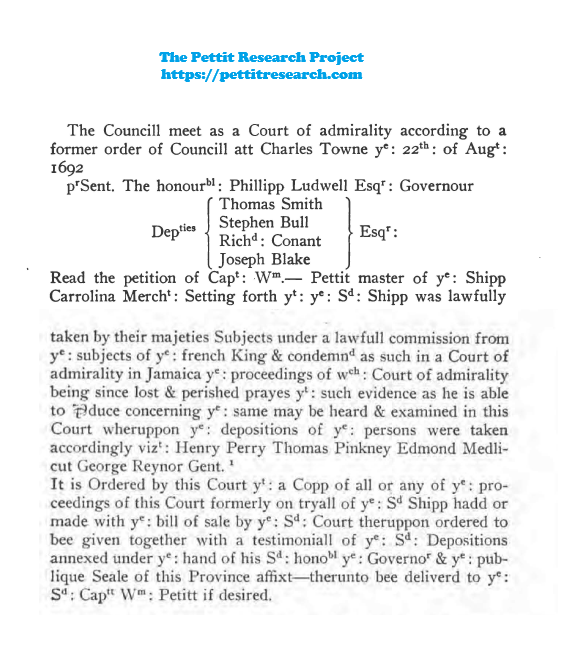
JOURNAL OF THE Grand Council OF SOUTH CAROLINA April 11, 1692-. September 26, 1692 Edited by A. S. SALLEY, JR. (Note the reference to the lost records in Jamaica.)
A month later, William Pettit sold the Carolina Merchant to Public Treasurer and Advocate-General, Jonathan Amory. Pettit may have saw an opportunity to “flip” the ship or Amory may have intended to acquire the ship all along. In either case, William Pettit functioned as a middleman which allowed Amory to avoid the negative perception of a conflict of interest. The Public Treasurer being involved in the condemning of a ship and then buying the ship directly himself for pennies on the dollar, would probably have raised some alarm.
The ship that began its life as a French frigate known as La Constance, was taken by English privateers and renamed the Loyal Jamaica. A mutiny resulted in a new name, Bachelor’s Delight, and a new mission as a pirate ship. Finally, it was repurposed and renamed the Carolina Merchant where it was briefly owned by Captain William Pettit before being sold to Jonathan Amory on September 29, 1692. Seven years later, in October/November of 1699 Amory and his wife died of yellow fever. There is no mention of any ships in their wills, and the history of the Carolina Merchant after it was sold to Amory is not known.
After the Court heard the pirates’ testimony, the men were accepted into society and became part of the ruling class. Captain Raynor used a portion of his fortune to purchase thousands of acres of land including a tract on Stono Island adjacent to William Pettit. In 1698 he was elected to the Assembly of Freeholders (Commons House of Assembly).
The pirate Thomas Pinckney multiplied his pirate fortune, and his progeny were some of the most prominent and prosperous figures in South Carolina for decades to come. This pirate’s grandson was one of signers of the United States Constitution. Two of Pinckney descendants served as governors of South Carolina, one of which served four terms. The Pinckney name was even used as a given name in many unrelated families whose parents revered the Pinckney dynasty. Several Pettit’s from South Carolina were given the Pinckney forename.
Captain William Pettit
Having given the back story regarding Pettit’s connection to the infamous Red Sea pirates, an overview of the life of Captain William Pettit is now in order. The events involving him can best be followed when laid out chronologically.
The date or place of the birth of William Pettit has yet to be discovered. His first entry in the timeline is actually based on a later record. We can infer from the 8-month wages settlement that occurred in May of 1692, that in September 1691, William Pettit was a captain of a ship known as the Treple Crowne. Captain Pettit’s crew consisted of at least the following men:
- John Skeech, Chief Mate
- Samuel Pope, Second Mate
- Thomas Blinman, Gunner
- Henry Oldridge, Mariner
- Alexander Dyer, Mariner
- Thomas Love, Mariner
- Jenkin Meredy, Mariner
William Pettit’s place of residence was Charles Towne, South Carolina. He was said to be “of the province of Carolina” and later land records confirm this. A record of the Council on January 2, 1692, which was a few months before the Red Sea pirates arrived states the following:
Carolina
Know all men by these presents that I William Pettitt of the province of Carolina Mariner am hodlen and firmely bound unto Edward Loughton of the province aforesaid Carpenter in the full and just Sum of Two hundred pounds Sterl to be paid to the said Edward Loughton his Certaine Attorney Executors Adminstrators and Assignes to which paymt well and truly to bee made I bind my selfe my Heirs Executors and Adtors for the whole and in the Whoel firmly by these presents Seald with my Seal Dated this second day of January 1692.
Though not always the case with ship captains or ship masters, the employ of a carpenter suggests Pettit may have been the actual owner of the ship he commanded. £200 was a large sum and most likely involved some sort of major overhaul on a ship. This would not be the last time he worked with Edward Loughton.
As previously noted, sometime in early May 1692, the Treple Crowne under the command of Captain Pettit with the abovenamed crewmen was ran aground in Charles Towne harbor, breaking the hull. The ship was condemned by the Court on Mary 13 along with the pirate vessel which had been abandoned. On May 16, members of George Raynor’s pirate crew were identified and prominent local citizens posted bail for them. Edward Loughton along with John Sullivan put down a total of £50 on behalf of pirate William Balloh.
On August 20, 1692, William Pettit asked the Council to meet as a Court of Admiralty to address an issue involving the pirate ship. On Monday, August 22, the Court of Admiralty was convened and the depositions of Henry Perry, Thomas Pinckney, Edmond Medlicut, George Reynor were taken. They described their acquisition of the French frigate La Constance in 1690 while acting as English privateers and its legal transfer to John Bell & Co. As already noted, this was to establish a “clean” title for the pirate ship (renamed Bachelor’s Delight) which now belonged to William Pettit as the Carolina Merchant. Just over a month later, on September 29, 1692, the Carolina Merchant was sold by Captain William Pettit to the Public Treasurer, Jonathan Amory.
On January 2, 1693, William Pettit entered into an agreement with Edward Laughton and gave him three bills of exchange “drawn upon Alexander Rood, goldsmith of London, England.” It was signed by William Pettit and witnessed by William Williams and James Moore. Alexander Rood was a London goldsmith who functioned as an early banker honoring bills of exchange. This suggests someone, either Pettit, Laughton or perhaps an unnamed partner must have been doing business in London as well as South Carolina.
Colonial grants revealed that William Pettit had a tract of land south of Charles Towne on Frosts Creek of Johns Island and none other than George Raynor owned neighboring land. On January 10, 1694, Captain George Raynor was granted 1,020 acres on the west side of the Stono River (Johns Island). This land was described as being adjacent to Pettit’s property.
On August 25, 1694, Pettit was commander of a ketch called James, and departed for Pennsylvania with a man named Captain Risbee. Captain James Risbee was another retired pirate but one who probably did not sail with Raynor’s crew to the Red Sea. It seems William Pettit was making coastal runs from Carolina to the northeast as opposed to the Caribbean or England. Also on board the James, was the ships “factor” or cargo agent, Joshua Harris. Harris was a freeholder and had ties to Jonathan Amory and Edward Loughton.
On November 22, 1694, George Raynor received another large grant of land on the Stono River and this land was again noted as being adjacent to Pettit. Another pirate, Robert Fenwick of “Fenwick Hall”, was also a neighbor of Pettit and Raynor. Pettit’s land was surrounded by retired pirates, he did business with retired pirates and he even sailed with a retired pirate.
William Pettit was active in commerce in 1696. On May 27 the January 2, 1693, agreement with Edward Loughton was memorialized.
On August 25, 1696, William Pettitt signed a debt bond for £48 to merchants William Bolough and James Gilchrist. Both of these men were original members of Raynor’s 1692 pirate crew. They had now established themselves as wealthy Charles Towne merchants, apparently fronting money for Pettit’s maritime trade business.
In 1699 a horrendous yellow fever epidemic fell on Charles Towne killing an estimated 15% of the population. There are no substantive records on William Pettit after this except one. On February 5, 1704, a land grant to George Frost for 200 acres on Stono Island at Frosts Creek noted that the land was “adj. Wm. Pettite.” At the time, the surveyors were fairly diligent about correctly listing only neighboring property owners who were alive. This indicates Captain William Pettit was still living near Charles Towne as late as 1704.
Since William Pettit was an established South Carolina resident, if he left a will it would have been recorded there. Unfortunately, there has been significant record loss in this time period. No will, inventory or probate records for Captain William Pettit have been located.
Oddly enough, a will for a William Pettit, mariner, who lived in Dover, Kent, England has been found. The will was written on December 8, 1696, and makes no mention of property in America. Though an unusual coincidence, it does not seem likely this was the same William Pettit. Other records in England suggest this was another Captain William Pettit who lived at the same time as the South Carolina William Pettit but operated mostly around England and the Mediterranean. The Dover mariner was probably this Englishman.
Conclusion
William Pettit’s origin has yet to be discovered. Pettit lived during the golden age of piracy in a place that was unofficially welcoming of pirates and their golden bribes. In life, William Pettit lived near and did business with some of the most successful buccaneers that ever lived. Records indicate he held close ties to a maritime syndicate of reformed pirates who had used their fortune to buy a place for themselves in high society. He managed to quickly recover from a ruinous disaster by seizing a rare opportunity to help the powers of the colony flip a ghost pirate ship. Captain Pettit was no stranger to the sea, making trips with a retired pirate along the east coast from Pennsylvania to South Carolina and maybe points beyond. There is, however, nothing to suggest he ever engaged in piracy himself. He was a successful merchant and master of at least three ships in his lifetime: Treple Crowne, Carolina Merchant, and James.
Life at sea was often a bachelors’ profession and perhaps for some it was a “bachelor’s delight.” It is not known if Captain William Pettit was ever married or if he left any heirs. Many mariners met their end at sea, but alas, just like his origin, the ultimate fate of Captain William Pettit is simply not known.
Like the article? Have more information? Please leave a comment below!