Nathan Pettit (b.1775) son of Joshua and Rachel Pettit of Spartanburg Co., SC Part II

Download the complete book for free from The Pettit Research Project:
 Nathan Pettit 1775-1855 of Spartanburg SC and Hancock, IL, Book.PDF
Currently Reading Part II
LIFE AT PETTIT CREEK
In 1835, Nathan Pettit set up a home, erected a barn, and built a mill on a plot of land in Hancock County, Illinois.[90] The soil was perfect for corn and wheat which they planted and harvested in abundance. He also did very well raising hogs.[91] After years of wandering, it seemed the restless settler had finally found his land of milk and honey.
The home site was most likely near the section line road on the northeast corner of the tract.[92] The mill was situated on the creek that passed through the southeastern tip of the Pettit land. A public road ran by the mill and still follows the same path today. The mill was a grist mill, used primarily for grinding grain and making flour or cornmeal. It was used not only by the Pettits but also by other nearby family farms. Neighbors associated the Pettit’s mill with the creek that supplied its power which quickly became known as “Pettit Creek.”
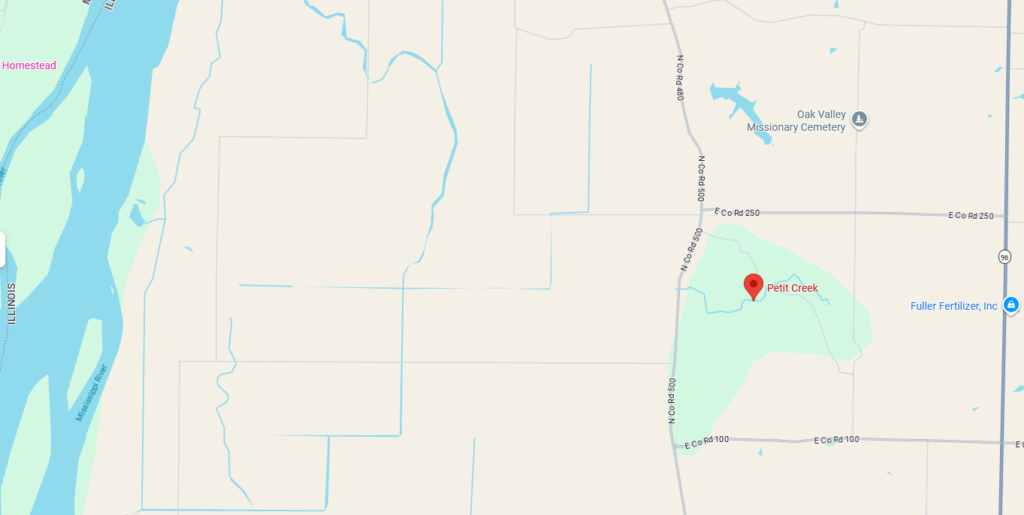
Petit Creek in Hancock County, Illinois. Click to view location in Google maps.
A man of about 25 years of age in 1835, Joseph Pettit, may have been one of the driving forces behind his father’s move to Hancock County. In August of 1835 he purchased 80 acres of land and another 80-acre tract a month later.[93] Edson Witney financed the second purchase and carried a mortgage on the land of $100 for one year.[94] On July 6 , 1837, Joseph and his bride Nancy B. Martin were the first two people to be joined in marriage in nearby Walker township. [95] The Reverend George Walker officiated. On October 27, 1837, Joseph Pettit sold his father, Nathan, both his 80-acre tracts for $350.[96]
Nathan’s son John W. also wasted no time branching out in the new home. He married Isabella Martin on the tenth of November in 1836 before David Hide, the Justice of the Peace.[97] Evidently Isabella did not survive more than three years. John was single again when he had his cattle mark recorded in the county record book on October 5, 1839.[98] The next day he married Lydia Martin with minister Isaiah Guyman performing the ceremony.[99]
Back in Ohio where Nathan’s eldest son Thomas had tarried, a second son, Benjamin F. Pettit, was born in June of either 1835 or 1836.[100],[101],[102],[103],[104] Sometime, most likely in 1836, Thomas Pettit died leaving his widow Nancy with the two Pettit boys behind.[105]
Nathan and his son Joseph, who had come to manage the farm, were involved in a handful of legal suits recorded in the Hancock County circuit court record books. In March of 1839, Nathan Pettit sued Joseph Steven for wrongfully taking a horse from him valued at $100. Witnesses named in the suit for Nathan’s case included Erastus Darby, Jeremiah Bently, Hampton Loftis, Nathan Pettit, Jr., John Pettit, and Aaron Pettit. [106] The case was appealed in 1841 and the judgment against Stevens upheld. [107]
On May 5, 1841, Stephen Owen sued Erastus W. Darby, Jeremiah Bartley, Hampton Loftis, and Joseph Pettit for trespass.[108]
Nathan Pettit was a defendant in a suit in 1845.[109] O. S. Freeman alleged that a bay horse in Nathan’s possession belonged to him. The case went to trial and, on June 20, 1845, the jury found in favor of Pettit. He was awarded costs for the suit as well. Witnesses who testified on his behalf were numerous and included Joseph Caldwell, William Davis, Hampton Loftis, Aaron Pettit, Charles D. Hill, Levi Jones, John Walls, Jeremiah Bently, William Martin, and John Slattery.
The second of the two 80-acre tracts Joseph Pettit purchased was sold to Nathan’s son-in-law Solomon Brashears in Ralls County, Missouri on October 27, 1839, for $100 by Nathan.[110] The rationale behind this transaction is not readily apparent but it may have been a simple mortgage financed by Brashears. After the purchase from Nathan Pettit, Solomon remained in Missouri and did not use the land himself. It is also possible there was some arrangement between Solomon and his brother William G. Brashears who had been in Missouri since 1827 and was looking for a change of scenery. The land would later find its way back into Nathan’s hands and eventually belong to Joseph before passing to John W.[111]
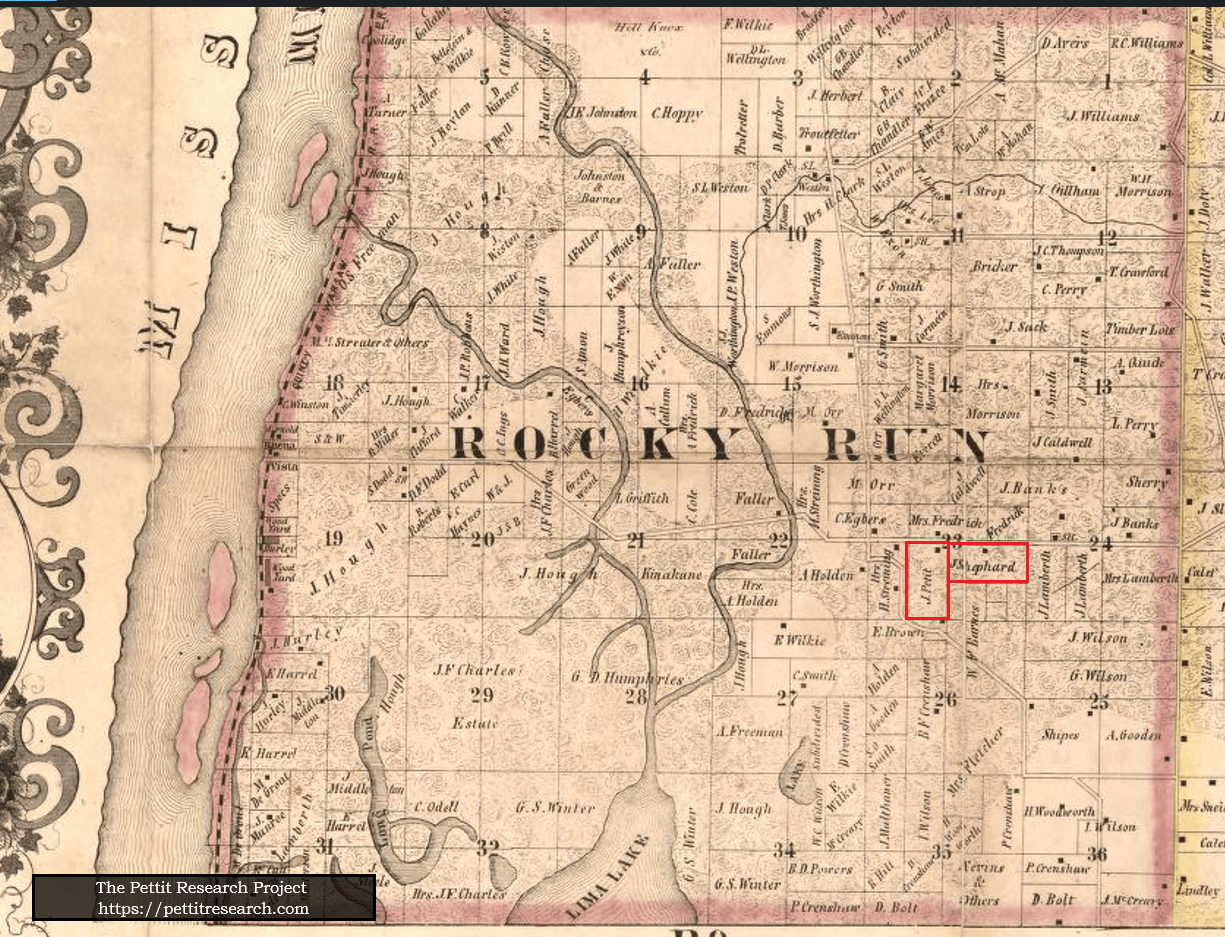 William G. Brashears fell in with the Pettits for a brief time in Illinois. Years later his family was captured on the 1860 Adair County, Missouri census. All but one of his children show to have been born in Missouri. The exception was Thomas A. Brashears who had an Illinois birthplace. This was Thomas Alexander Brashears who was the subject of a biography in A History of Northwest Missouri which gives his birthdate and place of birth as March 30, 1840, in Hancock County, Illinois. If William Brashears family did not move with the Pettits in 1835, they certainly would have been there by 1837. That year Joseph Pettit brought a legal suit against him. The details are lacking but John Pettit, Nathan Pettit, and Hampton Loftis testified on behalf of Joseph and the court decided in his favor. William G. Brashears was ordered to pay Joseph $13.70.[112] The case was appealed and on September 26, 1838, it was “dismissed for want of prosecution.” It was also “ordered that the defendant receive of the plaintiff his costs about his suit.”[113] William Brashears left Illinois with his wife and children for Missouri in 1841.[114]
In 1840 the census taker recorded Nathan Pettit as the only Pettit in this area of Hancock County who was the head of a household. In the home was 1 male age 60-70, one male age 20-30, one male age 15-20, and one female age 15-20. The 60 to 70-year-old was undoubtedly Nathan. The identities of the others are not easy to ascertain. No son of Nathan’s would fit in the 15-20 age bracket. There is evidence elsewhere that one family of Pettits had children who, for some reason, went to live with relatives.[115] This may have been the case in Nathan’s home.
Nathan’s youngest daughter Hannah was likely the female age 15-20. She was the youngest daughter and last wed. On June 1, 1843, Hannah married William H. Martin.[116] Her brother Nathan Pettit Junior married Polly Ann Zink on February 9, 1843, in Hancock County.[117]
Around 1844, Keziah and a boy who may have been her son, James, moved in with Nathan Pettit.[118] Keziah assumed the duties of managing the home. James was about 8 years old and grew up helping the Pettits with the farm.[119]
TROUBLE IN HANCOCK COUNTY
In 1845 Nathan’s name appeared in the Warsaw Signal newspaper alongside his son Joseph and son-in-law Hampton Loftis.[120] Warsaw was the largest town on the route between Rocky Run and Nauvoo and the newspaper was very much an anti-Mormon publication. The Pettit and Loftis families shared the paper’s sentiment. The public declaration that was printed in the paper stated that they, as Democrats, were as much opposed to the Mormons’ presence in Hancock County as were their Whig counterparts.
Speaking from a strict historical perspective, since they were self-proclaimed members of the Illinois Democratic Party, it would be safe to assume they did not leave South Carolina over concerns of slavery. While that increasingly divisive issue was not a problem for them in Illinois, they were part of a growing body of residents who were worried about the militarized religious group encamped at Nauvoo. The Mormon issue quickly came to a head. In 1846, the Mormons were expelled from Nauvoo and Hancock County’s population was reduced by about 12,000-15,000 residents.
Hampton Loftis shared Nathan Pettit’s sympathies. He and his wife Catherine Pettit stayed close to Nathan when they moved to Vermilion County, Illinois, in 1830, and again resided nearby in Hancock County when they moved there. The Loftis family is known to have had the following children before 1847: Lavina, William Daniel, Olive, and Elizabeth. This family is known to have attended New Harmony Baptist Church.[121] This Primitive Baptist church existed for about 35 years, but no complete membership list is extant. It is quite probable that New Harmony was also where Nathan Pettit attended church.
The Pettit and Loftis families would experience an unexpected death in 1847. Nathan’s daughter Catherine Pettit Loftis, wife of Hampton died that year. The cause of her death is not known but her illness may have been the reason for the expense charged to Nathan Pettit’s account with Doctor Aaron Holden on January 25, 1847.[122] Nathan paid for a doctor’s visit that included medicine, bloodletting, pills, and administration of “sugar of lead”. Sugar of lead was a highly toxic compound that was used to treat diarrhea. The illness may have been associated with typhoid fever, cholera, or malaria. Sadly, if this was indeed Catherine who was treated, she probably died in agony due, in part, to her treatment.
For the sake of maintaining his family, Hampton Loftis had to remarry quickly. He wed Rebecca Cobb on April 20, 1848, in Hancock County.[123] They had one child, Sarah, who was probably born in 1849.[124] The union was short lived, however.
About two miles to the west, the higher lands where the Pettits resided dropped off quickly into the bottom lands of the Mississippi River which were a haven for mosquito breeding and bacteria. The various sloughs emptied into Lima Lake which was a natural marshland that likely contained an abundance of stagnant water. It was drained in the 1930s and turned into farmland.[125] The mortality schedule for the area tells of deaths due to malaria and typhoid fever with the principal cause of death in Hancock County being cholera.[126] These are all common killers often due to swampy conditions and this may have been a recurring problem in the community where the Pettits lived as well. In the year 1848, for example, Dr. Aaron Holden made three visits to the Pettit home to treat someone’s apparent gastrointestinal illnesses. Then, sometime in September of 1849, Hampton Loftis became sick with “bilious fever”.[127] After a mere ten-day illness, the 38-year-old father passed away. The Loftis children of Catherine Pettit had now lost both of their parents in a matter of three years. The 1850 census reveals where two of the orphan children went.
1850 Hancock County, Illinois, census has the following people in Nathan Pettit’s home:
- Nathan Pettit, age 76, born in South Carolina, and his occupation is a miller.
- Daughter Keziah Wells, age 47, born in South Carolina.
- James Wells, age 14 (or 16), born in Missouri.
- Nathan Pettit, Jr., age 35, born in South Carolina
- Joseph Pettit, age 40, also born in South Carolina.
- Daniel Loftis, age 12, born in Illinois.
- Olive Loftis, age 9, born in Illinois.
Hampton died of fever in September 1849 and his son Daniel and daughter Olive were taken in by Nathan. In September of 1850 serious fever had struck and continued to strike the Pettit household. One or multiple occupants with critical fever were treated with “bloodletting and blistering” as well as calomel (mercury compound) on September 3, 4, and 9. On February 10, 1851, some sort of fever plagued them again, and again on May 18, 1851. The doctor’s records do not name the specific individual treated, only that it was charged to Nathan’s account. It is noteworthy, however, that Nathan Pettit, Jr., cannot be found in any records after the 1850 census and he was considered deceased by 1858 though his death may have occurred much earlier.
THE 1850s AND BEYOND
Five years after the 1850 federal census, the state of Illinois conducted an 1855 census. Nathan’s household included two males between the ages of 10-20, one male between the age 70 and 80 (Nathan, Sr.) and one female age 50-60 (Keziah age 53). Joseph Pettit was counted as head of his own household with one male age 30-40 and one female age 40-50.[128]
By 1855 Nathan was approaching his 80th year of life. With the blessing of a long life came some unwanted heartache. He had outlived a tragic number of his own children, their spouses, and grandchildren. Such was life in the 1800s, especially on the western frontier. By 1856 Nathan’s wife Levina, his children Jemima Pettit Brashears, Thomas Pettit, Rachel Pettit Tomlinson, Catherine Pettit Loftis, and Nathan Pettit, Jr., had all passed away. They fell in Ohio, Missouri, and Illinois and their graves have since been lost to the ages.
Despite the personal loss, Nathan had experienced a lot of blessings. He was not alone in life. Now in his late seventies, the old man probably realized he could no longer outwork his son Joseph in the field, but he still probably enjoyed his company. Records indicate he spent most of his time working at the mill while Joseph ran the cattle and hogs. Nathan undoubtedly enjoyed the meals prepared by his daughter Keziah as he settled in for the evening. From his front porch, Nathan could survey his 80-acre spread and plan all the work that needed to be done tomorrow. Perhaps in these quiet moments his mind would take him back to his early years in the back country of South Carolina. His boyhood home was hundreds of miles away; over the rugged mountains he had once led his family through. It would have seemed like a lifetime ago. The threat of being scalped by the Cherokee, the war for independence, the place where he met and married his wife and welcomed ten children into the world –this wild and wonderful place was where Nathan became a man. He had left it behind, but it was still a part of him. He had gone west in search of opportunities and tamed the frontier, forging a successful farm in an undeveloped land. Every day brought new challenges and every night brought him much needed rest. He had watched the seasons come and go. Seedtime and harvest. Summer and winter. He knew every season had its inescapable expectations, and Nathan was now in the winter season of his life.
Nathan became ill in March of 1856. In April, he requested help from Joseph Tillburn, his grandson-in-law, in making out his last will and testament.[129] He must not have been satisfied with the final draft because no signed will was ever produced. Mr. Tillburn attended to him throughout March and April of that year “nursing” him and giving him medicine.
Sometime in early May in the year 1856, the old pioneer, Nathan Pettit, died at his home in Hancock County, Illinois.[130] He was 79 years old.
AFTERWORD
Nathan died intestate and the court appointed a local man named John Banks as the administrator. He ran the customary advertisement in the newspaper in Carthage. Several creditors filed claims against the estate including Keziah and Joseph for their years of labor. An inventory was taken and sale conducted of household items. The heirs filed suit and the court demanded the sale of Nathan Pettit’s land in May of 1858 to cover the claims.[131] The home tract passed into the hands of Joseph Pettit. Joseph operated the farm until his death on April 15, 1868. His brother John W. was appointed as the administrator for Joseph’s estate and the land was then sold to Jacob D. Stromp by John W. Pettit in 1870.[132]
With the death of Joseph all that was left of the Nathan Pettit place in Rocky Run was the name of the creek. Modern-day maps still show “Petit” Creek meandering through the section of land that once belonged to Nathan Pettit and his family.
None of the old structures remain today, but surprisingly it seems the mill may have stood on Pettit Creek into the early 1900s. Local resident Gwen Barry, who owns land that adjoins the old home tract, recounted stories passed to her from an older generation that lived there. She gave The Pettit Research Project the following details:[133]
Mrs. Conover told us there was a mill across the road from her right on the creek. Never looked so I don’t know if there are traces of it.
Mrs. Conover (elderly lady) also told us there was a house and barn on our back property, which is across the road from the mill.
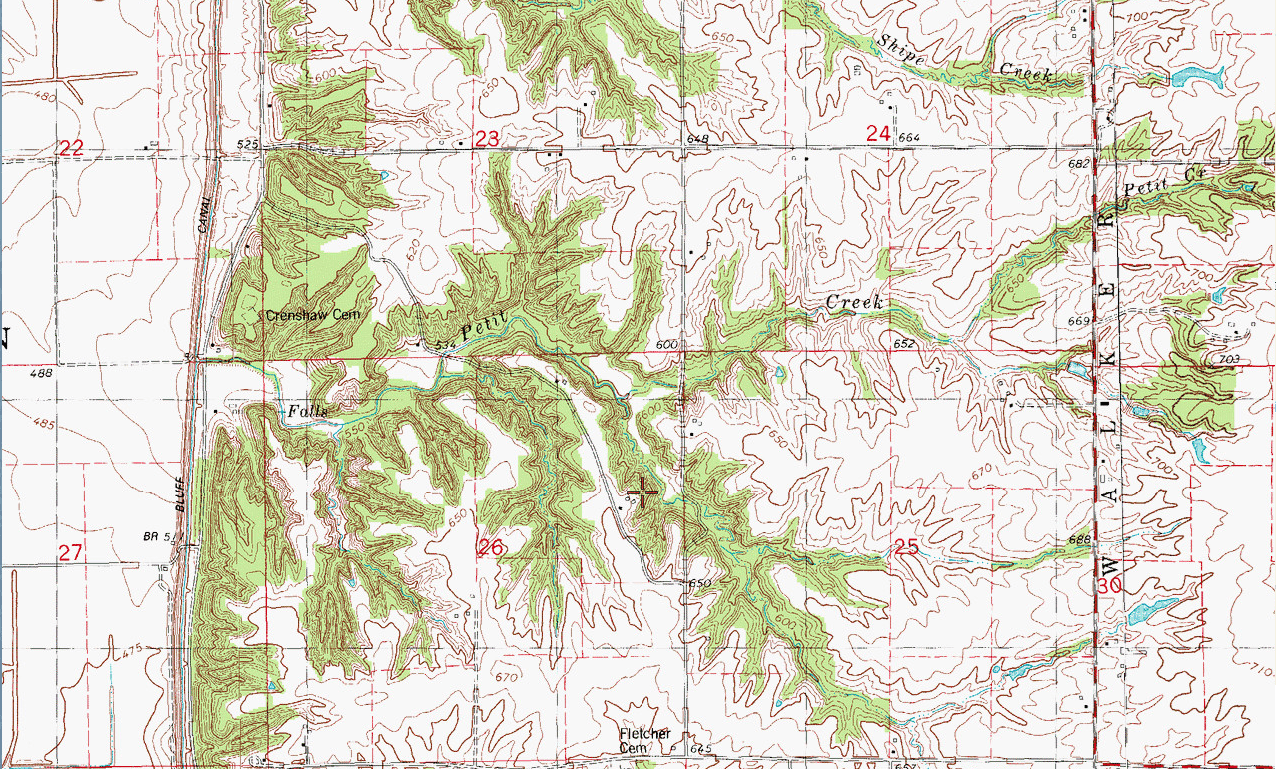
The Mrs. Conover she referred to owned property south and west of where the county road intersects Pettit Creek. This road consistently appears in the same basic location on all maps going back to at least 1859. Based on her description, it seems likely the mill was just north of the bridge over the road and back up the creek. The location Mrs. Conover described corresponds precisely with one of the 80-acre tracts originally purchased by Joseph Pettit in 1835.
On the Pettits’ land, the creek only passed through the southeastern corner of the property which narrows the possible site of the mill seat down to a small area. After leaving the Pettits’ old tract, Pettit Creek currently runs through the northern section of the Barrys’ land. Mrs. Barry described finding various artifacts that date to the pioneer period around this area. She stated:
Found thousands of broken crock pieces, window glass, dishes, bottles, and glass and metal ware too; on the acre where the homestead was.
I found a rubber button dated 1853 and a shard of a plate with the same date.
The 1853 button and plate date back to a time when Nathan Pettit still tended to the mill, when Joseph worked the farm, and when Keziah took care of domestic duties.
SOURCES
- Hancock County, Illinois probate record, Nathan Pettit, ibid. ↑
- Ibid. ↑
- Holmes & Arnold, and Charles Shober. Map of Hancock County, Illinois. [Illinois: Holmes & Arnold, Civil Engineers and Map Publishers, 1859] Map. https://www.loc.gov/item/2013593101/ ↑
- Hancock County (Illinois), Office of the County Clerk and Recorder, Carthage, Illinois, Land Book, Vol 109, 1817-1856, Family History Library Film 954296, Roll 75, Image Group 7943175, Filmed 15 Feb 1974, pp. 147, images, FamilySearch (https://www.familysearch.org/ark:/61903/3:1:3Q9M-CSZF-19WF-M); Entries for Joseph Pettit. ↑
- Hancock County (Illinois), Office of the County Clerk and Recorder, Carthage, Illinois, Deed Records Volume B, 1835-1836, Family History Library Film 954192, Roll 15, Image Group 8320183, Filmed 1 Feb 1974, pp. 29-30, images, FamilySearch (https://www.familysearch.org/ark:/61903/3:1:3Q9M-CSR1-PV6F); Deed of Joseph Pettit to Edson Whitney. ↑
- Hancock County (Illinois), Office of the County Clerk and Recorder, Carthage, Illinois, Marriage Records Volume A-1, 1829-1849, Family History Library Film 954177, Roll 2, Image Group 4661306, Filmed 29 Jan 1974, p. 18, images, FamilySearch (https://www.familysearch.org/ark:/61903/3:1:939J-V19K-6H); Joseph Pettit marriage to Nancy B. Martin. ↑
- Hancock County (Illinois), Office of the County Clerk and Recorder, Carthage, Illinois, Deed Record Book, Volume 10E, 1837-1838, pp. 163-164; Joseph Petit to Nathan Petit. ↑
- Hancock County (Illinois), Office of the County Clerk and Recorder, Carthage, Illinois, Marriage Certificates, Family History Library Film 91390246, Roll 145, Filmed 11 Dec 1987, pp. 507-511, images, Image Group 4661406, FamilySearch (https://www.familysearch.org/ark:/61903/3:1:939J-KQHH-T); John Pettit marriage to Isabella Martin. ↑
- Hancock County (Illinois), Office of the County Clerk and Recorder, Carthage, Illinois, Marks and Brands, Family History Library Film 954296, Roll 75, Image Group 4661407, Filmed 15 Feb 1974, p. 357, images, FamilySearch (https://www.familysearch.org/ark:/61903/3:1:3Q9M-CSZF-19WL-Q); “John Pettit with smooth cropp off the left and a swallow fork in the right ear.” ↑
- Hancock County (Illinois), Office of the County Clerk and Recorder, Carthage, Illinois, Marriage Certificates, Family History Library Film 91390246, Roll 145, Filmed 11 Dec 1987, pp. 1038, images, Image Group 4661406, FamilySearch (https://www.familysearch.org/ark:/61903/3:1:939J-KQQ9-M); John Pettit marriage to Liddy Martin. ↑
- 1850 U.S. Census, Butler County, Ohio, population schedule, Oxford Township, p. 815, household 432, family 432, line 16, household of Dr. Joel Fithian showing Benj. F. Pettet, NARA microfilm publication M432, Roll 663, National Archives and Records Administration, Washington D.C. ↑
- 1860 U.S. Census, Edgar County, Illinois, Simms Township, population schedule, p. 109, dwelling 777, family 742, line 5, household of Nancy C Vanhorn showing Benjamin F. Pettit, NARA microfilm publication M653, Roll 176, National Archives and Records Administration, Washington D.C. ↑
- 1880 U.S. Census, Highland Township, Guthrie County, Iowa, population schedule, p. 5, dwelling 34, family 39, household of B. F. Pettit, NARA microfilm publication T9, Roll 342, National Archives and Records Administration, Washington D.C. ↑
- 1900 U.S. Census, Polk County, Iowa, population schedule, Des Moines Township, Enumeration district 69, p.22B, dwelling 464, family 451, line 93, household of Benjamin Pettit, NARA microfilm publication T623, Roll 305, NARA, Washington D.C. ↑
- 1910 U.S. Census, Los Angeles County, California, population schedule, Los Angeles township, precinct 184, p. 5B, dwelling 139, family 148, line 83, household of William J. Tracy showing father-in-law Benjamin F. Pettit, NARA microfilm publication T623, Roll 305, NARA, Washington D.C. ↑
- Hancock County, Illinois probate record, Nathan Pettit, ibid.; “one or two heirs.” ↑
- Hancock County (Illinois), Circuit Clerk of the Circuit Court, Carthage, Illinois, Civil and Criminal Files, Item 1, Family History Library Film 1521253, Roll 49, Image Group 7635673, Filmed 14 Oct 1987, pp. 92-112, images, FamilySearch (https://www.familysearch.org/ark:/61903/3:1:3QS7-L9LH-HN1N). ↑
- Hancock County (Illinois), Circuit Clerk of the Circuit Court, Carthage, Illinois, Circuit Court Record, Volume B, 1838-1840, Family History Library Film 3523501403, Roll 37, Image Group 8115511, Filmed 7 Mar 1974, p. 70, images, FamilySearch (https://www.familysearch.org/ark:/61903/3:1:3Q9M-CSV7-198Y-N). ↑
- Hancock County (Illinois), Circuit Clerk of the Circuit Court, Carthage, Illinois, Civil and Criminal Files, Volume B, 1838-1840, Family History Library Film 1521253, Roll 49, Image Group 7635673, Filmed 14 Oct 1987, p. 299, images, FamilySearch (https://www.familysearch.org/ark:/61903/3:1:3QS7-L9LH-HJ13). ↑
- Hancock County (Illinois), Circuit Clerk of the Circuit Court, Carthage, Illinois, Civil and Criminal Files, 1844-1846, Item 2, Image Group 4057854, Filmed 14 Oct 1987, pp. 299-350, images, FamilySearch (https://www.familysearch.org/ark:/61903/3:1:3QS7-L9LH-Y6L6). ↑
- Hancock County (Illinois), Office of the County Clerk and Recorder, Carthage, Illinois, Deed Record Book, Volume 10E, 1837-1838, pp. 249-250; Nathan Pettit to Solomon Breshers. Sold E1/2 SW 1/4 S23 3N 9W, 80AC. ↑
- Hancock County (Illinois), Office of the County Clerk and Recorder, Carthage, Illinois, Deed Record Book, Volume 86, 1870-1871, pp. 15-16; John W. Pettit to Jacob D. Stromp. Sold E1/2 SW 1/4 S23 3N 9W, 80AC. ↑
- Hancock County (Illinois), Office of the County Clerk and Recorder, Carthage, Illinois, Probate Files, Box 5, Item 2, Family History Library Film 81390201, Roll 15, Image Group 8576224, Filmed 21 Sept 1987, pp. 1034-1043, images, FamilySearch (https://www.familysearch.org/ark:/61903/3:1:3Q9M-C37H-1SKZ-R). ↑
- Hancock County (Illinois), Circuit Clerk of the Circuit Court, Carthage, Illinois, Circuit Court Record, Volume B, 1838-1840, Family History Library Film 3523501403, Roll 37, Image Group 8115511, Filmed 7 Mar 1974, p. 35, images, FamilySearch (https://www.familysearch.org/ark:/61903/3:1:3Q9M-CSV7-19DS-K). ↑
- Walter Williams, A History of Northwest Missouri, Volume 3 (Chicago, The Lewis Publishing Company, 1915) 1991; This book also gives other genealogical information of note to wit: father William G. Brashear b. Jan 13, 1807, in Spart. Co., SC, d. May 10, 1862, Adair Co., MO; mother b. Sep 22, 1809, d. Aug 29, 1900. Parents “married in their native community.” ↑
- 1850 U.S. Census, Ralls County, Missouri, population schedule, Enumeration district 73, p.178, dwelling 535, family 540, line 5, household of Merada Brashears; NARA microfilm publication M432, Roll 411, National Archives and Records Administration, Washington D.C. ↑
- Hancock County (Illinois), Office of the County Clerk and Recorder, Carthage, Illinois, Marriage Certificates, Family History Library Film 91390246, Roll 145, Filmed 11 Dec 1987, p. 1653, images, FamilySearch (https://www.familysearch.org/ark:/61903/3:1:939J-K3S1-63); William H. Martin marriage to Hannah Pettit. ↑
- Hancock County (Illinois), Office of the County Clerk and Recorder, Carthage, Illinois, Marriage Records Volume A-1, 1829-1849, Family History Library Film 954177, Roll 2, Image Group 4661306, Filmed 29 Jan 1974, p. 1572, images, FamilySearch (https://www.familysearch.org/ark:/61903/3:1:939J-V19K-6H); Nathan Pettit marriage to Polly Ann Zink. ↑
- Hancock County, Illinois probate record, Nathan Pettit, ibid; In 1857 Keziah gave a plaintiff statement regarding the estate of Nathan Pettit. She said she had lived with him for 12 years prior to his death and took care of the house. ↑
- Ibid. ↑
- “To the Democrats of the State of Illinois,” Warsaw (Illinois) Signal, 14 May 1845, p. 2. ↑
- Robert Webb, “A Study of New Harmony Church, Colonel Levi Williams, the Militia Companies Under His Command, and the Expulsion of the Mormons from Hancock County, Illinois,” n.d., archived 11 Jun 2011 at https://web.archive.org/web/20110611020414/https://www.carthage.lib.il.us/community/churches/primbap/MormonTrouble.html ↑
- Hancock County, Illinois probate record, Nathan Pettit, Ibid. ↑
- Hancock County (Illinois), Office of the County Clerk and Recorder, Carthage, Illinois, Marriage Records Volume A-1, 1829-1849, Family History Library Film 954177, Roll 2, Image Group 4661306, Filmed 29 Jan 1974, p. 119, images, FamilySearch (https://www.familysearch.org/ark:/61903/3:1:939J-V19V-P7); Hampton Loftis marriage to Rebecca Cobb. ↑
- 1850 U.S. Census, Page County, Iowa, population schedule, Enumeration district 22, p. 4, household 268, family 268, line 18, household of Sarah Jackson, NARA microfilm publication M432, Roll 663, National Archives and Records Administration, Washington D.C.; Rebecca Loftis in the home of Sarah Jackson with children Frances Loftis and Sarah. ↑
- Linda Riggs Mayfield, “Land rich in game later threatened by farm predators,” Historical Society of Quincy & Adams County, 29 Apr 2018, https://www.hsqac.org/land-rich-in-game-later-threatened-by-farm-predators8b1b2a8a/ ↑
- “Illinois, Non-Population Census Schedules, 1850-1880,” Hancock County, Illinois, mortality schedule, p. 325, enumerator’s notes; (National Archives and Records Administration microfilm publication T1133, Roll NARA, Washington D.C. ↑
- “Illinois, Non-Population Census Schedules, 1850-1880,” Hancock County, Illinois, mortality schedule, p. 311, line 14, Hampton Loftis; (National Archives and Records Administration microfilm publication T1133, Roll NARA, Washington D.C. ↑
- “State Census 1855, Hancock County”, Illinois State Historical Society, Springfield, Illinois, Illinois Secretary of State, Image Group 976183, p. 4, line 10, images, FamilySearch, (https://www.familysearch.org/ark:/61903/1:1:61HH-DPZ); Nathan Pettit and Joseph Pettit ↑
- Hancock County, Illinois probate record, Nathan Pettit, ibid; “1856, in March and April for nursing and plain medicine for Nathan Pettet in his last sickness $30.00. In April for attempts or efforts to make the will of Nathan Pettet at his request $35.00.” ↑
- Hancock County, Illinois probate record, Nathan Pettit, ibid; “May 8, 1856… eight dollars for coffin for Nathan Pettet” ↑
- Hancock County (Illinois), Office of the Circuit Clerk, Carthage, Illinois, Chancery Records, Ibid. ↑
- Hancock County (Illinois), Office of the County Clerk and Recorder, Carthage, Illinois, Deed Record Book, Volume 86, 1870-1871, Family History Library Film 3523501403, Roll 58, Image Group 8203236, Filmed 13 Feb 1974, pp. 15-16, images, FamilySearch (https://www.familysearch.org/ark:/61903/3:1:3Q9M-CSLR-6336-X); Deed of John W. Pettit to Jacob D. Stromp ↑
- Gwen Barry to Brandon Pettit, 11 Jan 2023, letter, The Pettit Research Project questionnaire response returned. ↑